Q1 growth rate seen at 3.5%
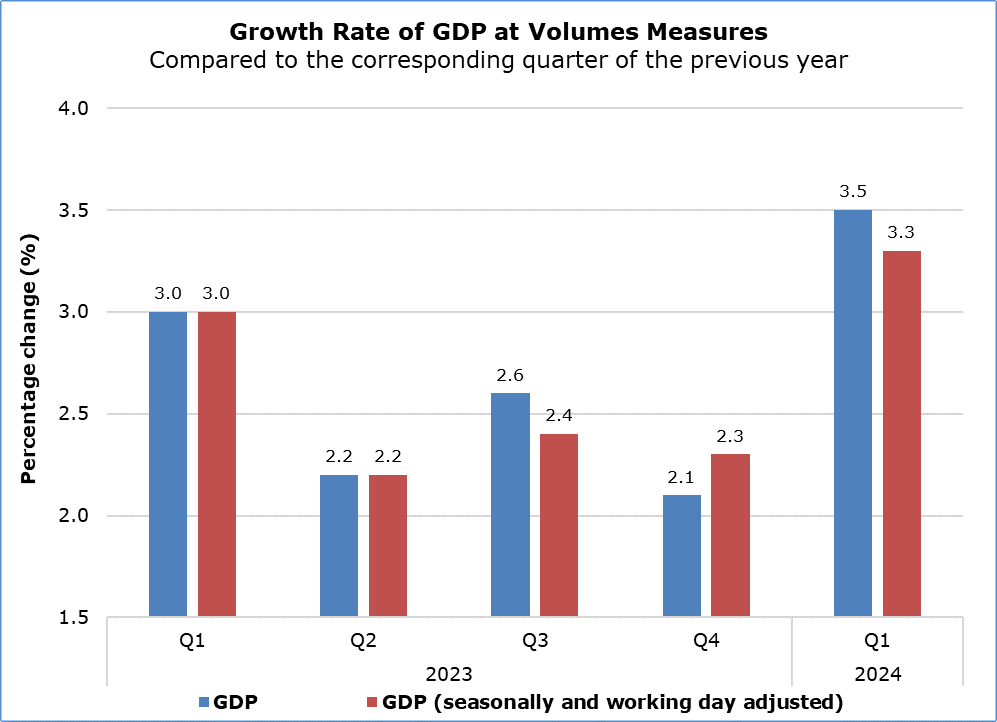
The Cyprus economy’s growth rate in real terms during the first quarter of 2024 is positive, with a gross domestic product estimated at 3.5% year-on-year according to Cystat.
The Cyprus economy’s growth rate in real terms during the first quarter of 2024 is positive, with a gross domestic product estimated at 3.5% year-on-year according to Cystat.
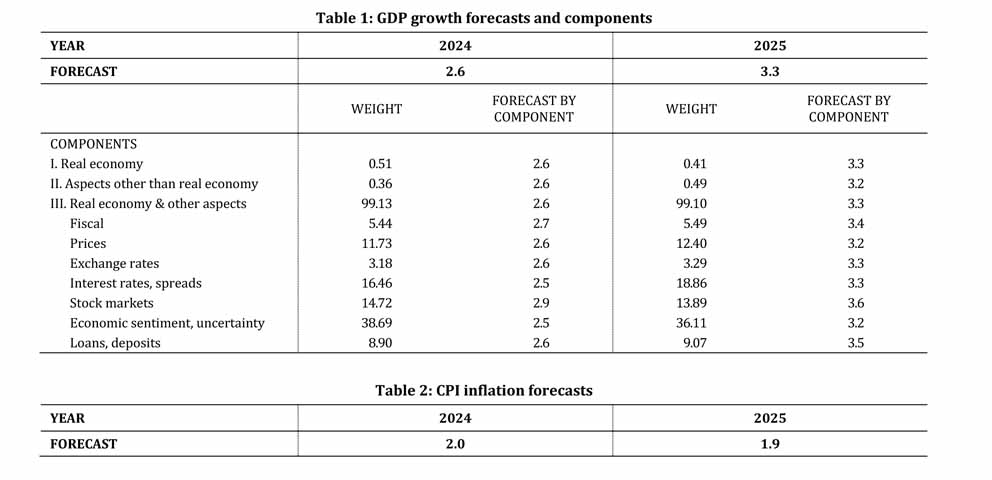
Real activity growth in Cyprus is expected to continue at a similar pace as in 2023 and gather momentum in 2025, with real GDP growth forecasted at 2.6% in 2024 and 3.3% in 2025. The growth forecasts have been revised up from previous estimates.

Capital Intelligence has revised upwards the sovereign ratings for Cyprus due to a faster than projected decline in general government debt, consistent primary fiscal surpluses, proactive debt management, progress in clearing up non-performing loans in the banking system, and declining government contingent liabilities from the banking sector.

Morningstar DBRS has confirmed Cyprus’ sovereign ratings at BBB (high) due to strong economic growth, but warned of exposure to geopolitical shocks and constraints from a small services sector. The stable trend balances favorable economic and fiscal developments against downside risks. Economic growth is driven by tourism, ICT relocations, and investment projects, with the Central Bank forecasting GDP growth to strengthen. Public debt has decreased, with further declines projected, and interest burden offset by favorable debt profile. Challenges include non-performing loans in the banking sector and low labor productivity. The ratings are supported by a stable political environment, sound fiscal policies, and EU membership.

– Risks associated with loans for Cypriot banks are expected to decrease due to economic growth, declining inflation, and unemployment rates.
– Moody’s predicts a decline in bank profits from recent highs.
– A gradual decrease in net interest margins is anticipated due to rising deposit costs and falling interest rates, influenced by competition and high levels of private sector debt.
– Stricter loan criteria and loan restructuring efforts are improving loan quality and reducing problematic loans.
– Asset quality risks from foreclosed properties are diminishing, supported by a strong real estate market.
– The banking sector in Cyprus is characterized by a low loan-to-deposit ratio and ample liquidity reserves.
– Cyprus’ GDP is forecasted to grow by 2.8% in 2024 and 3.2% in 2025-27, outpacing the euro area by 0.8% in 2024.
– Economic growth is supported by diversification in the services sector and significant foreign direct investment projects.
– Moderate growth in the loan portfolio is expected due to the banking system’s saturation, high private sector debt, and elevated interest rates.
– Monetary policy is expected to remain restrictive, even with interest rate reductions by the European Central Bank.
– The NPE ratio is expected to decrease below 3% this year.
– The proportion of foreclosed assets relative to bank equity is decreasing, supported by the real estate market.
– Capital risks are declining, with banks completing risk release and balance sheet restructuring.
– The Common Equity Tier 1 ratio for assessed banks increased to 18.8% at the end of 2023.
– Moody’s assessment focuses on Cyprus’ two largest domestic banks, Bank of Cyprus and Hellenic Bank, which represent a significant portion of the banking system’s assets.
– The weighted average Baseline Credit Assessment of the two major banks is ba2, with a weighted average asset-based deposit rating of Baa3.

The European Commission’s interim winter forecast indicates that Cyprus is expected to see its GDP grow by 2.8% in 2024 and by 3% in 2025. Inflation in Cyprus is forecasted to slow to 3.9% in 2023, down from 8.1% in 2022, and is expected to be further contained to 2.4% in 2024 and 2.1% in 2025. The main drivers of GDP growth in Cyprus are strong domestic demand, strategic investments, and lower energy prices. The Recovery and Resilience Mechanism is expected to support investments that will strengthen growth. Economy Commissioner Paolo Gentiloni presented the winter forecast, noting that the European economy is entering 2024 on a weaker footing than previously predicted. The EU and eurozone growth forecasts for 2023 have been revised to 0.5%, and for 2024, they have been adjusted to 0.9% in the EU and 0.8% in the eurozone. The commission predicts an increase in economic activity in 2025, with growth of 1.7% in the EU and 1.5% in the eurozone. Inflation in the EU is expected to decrease from 6.3% in 2023 to 3.0% in 2024 and further to 2.5% in 2025. In the Eurozone, inflation is projected to slow from 5.4% in 2023 to 2.7% in 2024 and to 2.2% in 2025. The contribution of net exports to Cyprus’ economy is expected to remain weak due to economic uncertainty in trading partners and strong demand for imports. Real GDP growth in Cyprus slowed to 2.5% year-on-year in the first three quarters of 2023, but tourism services demand continued to recover. Economic activity in the EU is expected to pick up in 2024 after a weak start to the year. Lower energy prices have led to a faster-than-expected decline in headline inflation in 2023. The forecasts are subject to uncertainty due to geopolitical tensions and the risk of conflict expansion in the Middle East. Rising shipping costs due to trade disruptions in the Red Sea are expected to exert only a slight influence on inflation. Risks to core growth and inflation forecasts include consumption, wage growth, profit margins, interest rates, and the impact of extreme weather events due to climate change.
The European Commission’s interim winter forecast predicts that Cyprus will see further growth in its Gross Domestic Product (GDP) in 2024, with an expected rise of 2.8 percent, and an increase of 3 percent in 2025. Inflation in Cyprus is forecasted to slow to 3.9 percent in 2023, down from 8.1 percent in 2022, and is expected to be further contained to 2.4 percent in 2024 and 2.1 percent in 2025. The main driver of GDP growth in Cyprus is projected to be strong domestic demand, with significant contributions from strategic investments and lower energy prices. Growth is also expected to be supported by investments from the Recovery and Resilience Mechanism. However, net exports are expected to contribute weakly to the economy due to economic uncertainty in Cyprus’ main trading partners and strong demand for imports driven by investments. The European Commission revised the growth forecasts for the EU and the eurozone for 2023 to 0.5 percent and adjusted the 2024 forecasts to 0.9 percent for the EU and 0.8 percent for the eurozone. Inflation in the EU is forecasted to decrease from 6.3 percent in 2023 to 3.0 percent in 2024, and further to 2.5 percent in 2025. In the Eurozone, inflation is projected to slow from 5.4 percent in 2023 to 2.7 percent in 2024, and to 2.2 percent in 2025.

The European Commission has published its Winter 2024 Economic Forecast, which lowers the growth outlook for this year and sets inflation on a lower downward path than projected last autumn. In Cyprus, real GDP growth slowed down to 2.5% in the first three quarters of 2023 compared to 5.8% for the same period in 2022. However, demand for tourism services continued to rebound in 2023, with arrivals increasing by 20.1%. Private consumption remained robust, supported by real wage increases and employment growth. For the whole of 2023, economic activity is expected to have grown by 2.4%. In 2024 and 2025, real GDP in Cyprus is expected to grow by 2.8% and 3% respectively. Harmonized index of consumer prices (HICP) inflation in Cyprus is set to moderate to 2.4% in 2024 and 2.1% in 2025.
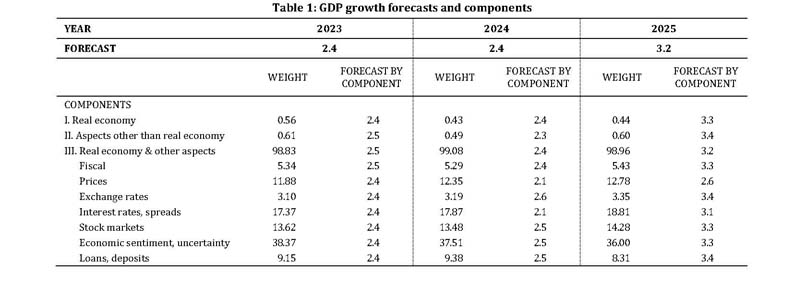
The University of Cyprus has estimated that real GDP growth in Cyprus will slow from 5.1% in 2022 to 2.4% in 2023. Economic growth is projected to remain at 2.4% in 2024 and improve to 3.2% in 2025. The forecast for 2023 has remained unchanged, but the forecast for 2024 has been revised down by 0.4 percentage points. The slowdown in growth in 2023 is attributed to tightening monetary policy and geopolitical turmoil. Despite the slowdown, economic activity and the labor market in Cyprus have remained resilient, and inflation has gradually decelerated. Inflation is projected to decrease from 3.5% in 2023 to 2.1% in 2024 and 2.0% in 2025. Risks to the growth outlook are tilted to the downside, while risks to the inflation outlook are skewed to the upside due to increased geopolitical turmoil.