Consumers would see power price cuts with Interconnector

Consumers would see power price cuts with Interconnector

Fact: The Great Sea Interconnector project, a subsea electricity cable linking Cyprus to Greece, is estimated to save an average household consuming five megawatt-hours of electricity annually at least €400 a year.

‘Cyprus is a reliable business centre’

‘Cyprus is a reliable business centre’

– Cyprus is considered a reliable business center by Commerce Minister George Papanastasiou.
– The Eastern Mediterranean region can play a role in ensuring Europe’s energy security.
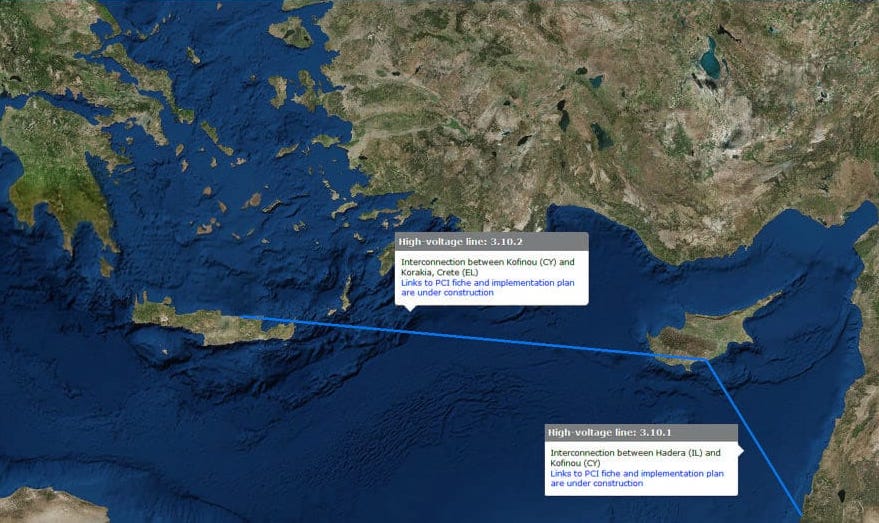
– The Great Sea Interconnector project aims to connect the electricity systems of Cyprus, Greece, and Israel to aid Europe in becoming independent of Russian gas.
– Greek Energy Minister Theodoros Skylakakis warned the Cypriot government about missing deadlines for the interconnector project.
– The Cypriot government is still in the phase of discussing conditions and waiting for Greece’s transmission system operator Admie to submit a cost-benefit analysis of the project.

Great Sea Interconnector will offer , ‘triple energy benefits’

Great Sea Interconnector will offer , ‘triple energy benefits’

The Great Sea Interconnector project will offer triple benefits to Cyprus, including better energy security, a ‘green mix’ of power generation, and cheaper energy for all consumers.

Benefits of cable sought before investment decision made

Benefits of cable sought before investment decision made

The government of Cyprus has asked Greece’s Independent Power Transmission Operator (Admie) to carry out a cost-benefit analysis for the Great Sea Interconnector project, which aims to link the electricity grids of Cyprus, Greece, and Israel. The project, previously known as the EuroAsia Interconnector, is estimated to cost €1.9 billion. Cyprus is considering investing €100 million in the project and wants an updated analysis before making a final decision.

Chinese-led group to visit Vasiliko over stalled LNG plant

Chinese-led group to visit Vasiliko over stalled LNG plant

High-level officials from a Chinese-led consortium responsible for constructing the liquefied natural gas (LNG) terminal at Vasiliko in Cyprus are expected to visit within the week. Energy Minister George Papanastasiou announced that the government will request a timetable for consultations between the parties and mentioned that if a positive outcome is not reached, a joint decision to suspend cooperation will be made. He highlighted that work on the terminal has stopped as the government wants to know the company’s plans and when the floating unit, currently in Shanghai, will be certified. Papanastasiou emphasized that building the LNG terminal at Vasiliko is the fastest way to introduce natural gas for electricity generation in Cyprus, aiming to reduce emissions and lower electricity costs. Additionally, Cyprus plans to participate in the Great Sea Interconnector project with an investment of up to €100 million, with consultations ongoing with investment funds and the Independent Power Transmission Operator (IPTO). A meeting with the largest investment fund interested in the project, from the United Arab Emirates, IPTO, and the energy ministry, is scheduled to take place to shape the course of this project.

Govt to participate in interconnector project , – if conditions met

Govt to participate in interconnector project , – if conditions met

The government of Cyprus, represented by Finance Minister Makis Keravnos, has expressed its intention to participate in the Great Sea Interconnector project alongside Greece and Israel, contingent upon the fulfillment of specific conditions set by the cabinet. This project aims to end Cyprus’s energy isolation by connecting the island to the energy networks of Europe and enhancing energy security. The decision comes after discussions with Greece’s Independent Power Transmission Operator (IPTO), which has urged Cyprus to expedite its participation with a contribution of up to €100 million. Keravnos highlighted the project’s significant geopolitical value and the need to assess all financial costs and potential risks before making a final government decision.