It’s not the economy, stupid

It’s not the economy, stupid

For the first time in decades, the dominant pre-election issue in the US is not the economy, but migration. Gerald Baker, a columnist and executive at the Wall Street Journal, made this observation. The phrase “it’s the economy, stupid,” has been a central slogan for most election campaigns, emphasizing the importance of the economy in elections. However, the pivotal issue in the 2024 elections is migration. The US has experienced a massive influx of illegal immigrants under President Joe Biden’s administration, with at least six million estimated arrivals. This situation has become a problem not only for border states but also for many cities, including New York. Many Americans are concerned about the costs, the large number of arrivals, and the involvement of some migrants in criminal activities. This shift in concern towards migration reflects a profound change in the public mood and indicates a broader disillusionment with the current political system.

Incentive plans for jobs for unemployed

Incentive plans for jobs for unemployed

The Cabinet approved two incentive plans for the employment and training of 1,265 unemployed people with a total budget of €11,694,000. The plans aim to employ and train 815 unemployed persons under 30 years of age and employ 450 unemployed persons using flexible forms of work through distance work. This initiative is part of the government’s policy to activate domestic human resources and achieve full employment conditions. The sectors covered by the scheme are unrestricted.

EURGBP gains ground following UK jobless, German CPI

EURGBP gains ground following UK jobless, German CPI

– Euro-Sterling was trading below the mid-0.8500s during early European trading on Tuesday.
– The EURGBP cross was trading around 0.8540, gaining 0.16% on the day.
– The UK ILO Unemployment Rate increased to 3.9% in the three months to February from 3.8%.
– The number of people claiming jobless benefits in the UK rose by 16,800 in February.
– The UK Employment Change was -21,000 in January.
– The German Consumer Price Index (CPI) for February was 0.4% MoM and 2.5% YoY.
– The German Harmonized Index of Consumer Prices (HICP) for February was 0.6% MoM and 2.7% YoY.
– Upcoming data releases include the UK monthly GDP, Industrial Production, Manufacturing Production, and Trade Balance for January.

Real estate sector depends on outside factors

Real estate sector depends on outside factors

The Cyprus economy has shown strong resilience, recording one of the highest growth rates in the European Union, according to Dr. Giorgos Mountis, CEO of Delfi Partners. The Cypriot economy grew by 2.4% in 2023 and is estimated to grow by 2.8% in 2024 and 3% in 2025. Inflation decreased from 8.1% in 2022 to 3.9%, with further reductions expected to 2.4% in 2024 and 2.1% in 2025. Efforts to contain inflation involved decisions that temporarily affected citizens’ incomes, with interest rate increases placing significant pressure on household incomes. However, optimism exists that the European Central Bank’s decisions will start to change in 2024, potentially leading to a decrease in domestic interest rates. Unemployment is at very low levels, approaching full employment, though many sectors face personnel shortages. The government’s strategies to employ and attract foreign labor could lead to an increase in the country’s population and economic development. The real estate sector remained resilient in 2023, with sales contracts increasing by 16% compared to 2022, reaching the highest level since 2008, driven by increased demand from non-European buyers. Apartment prices in 2023 exceeded those of 2010 for the first time, according to the Central Bank of Cyprus, leading to an increase in properties purchased for rental investment.

Gold rally could extend beyond recent highs

Gold rally could extend beyond recent highs

Gold has increased by nearly 19% since a low in October and about 7% in the past month. UBS strategists suggest there might be a short-term pullback in gold prices, but the rally could continue over the year. Factors supporting gold include potential Federal Reserve rate cuts, central banks and investors buying gold, and increased geopolitical risks. Gold prices have surpassed ,180, reaching near ,200 highs in Asian trading. The Federal Reserve’s potential rate cuts this year and ongoing geopolitical tensions are supporting gold’s value. Fed Chair Jerome Powell indicated the U.S. economy is healthy, and rate cuts could begin once there is confidence in inflation’s downward trajectory. Futures markets anticipate a 70% chance of the Fed cutting rates by mid-June, with a total of one percentage point reduction by year-end. U.S. Nonfarm Payrolls (NFP) data for February showed 275,000 jobs added, exceeding expectations and potentially influencing Fed rate decisions. China’s inflation data for February indicates a return to normal consumption levels, positively affecting gold prices as China is a major consumer of gold. The Chinese Consumer Price Index (CPI) increased by 0.7% year-over-year in February, and the Producer Price Index (PPI) declined by 2.7% year-over-year in the same month. Upcoming U.S. CPI and Retail Sales data for February are awaited for further market direction, with CPI expected to increase by 0.4% month-over-month and Retail Sales projected to rise by 0.7% month-over-month.

Gold extends rally above $2,160 ahead of US NFP

Gold extends rally above $2,160 ahead of US NFP

The price of gold reached a new all-time high above ,160, influenced by a weaker US Dollar, a decline in US Treasury bond yields, and expectations for a rate cut by the Federal Reserve in June. Dovish commentary from central bank policymakers, including Fed Chair Jerome Powell and European Central Bank chief Christine Lagarde, also supported gold prices. Powell indicated the Fed is close to being confident enough to cut rates, while Lagarde suggested the ECB might ease policy in June. Additionally, geopolitical tensions and safe haven buying, particularly following a Houthi attack in the Red Sea, contributed to the demand for gold. Despite investors pulling metal out of Gold-backed ETFs, central banks remain strong buyers of gold.

Gender disparity remains in the workplace, says PwC study

Gender disparity remains in the workplace, says PwC study

– Global progress on achieving gender parity at work is slow, according to PwC’s Women in Work Index and Inclusion Matters studies published for International Women’s Day 2024.
– The 2024 Women in Work Index indicates it will take over 50 years to close the gender pay gap across 33 OECD countries.
– The Women in Work Index measures gender equality at work in the OECD using five indicators: the gender pay gap, female labor force participation rate, gap between male and female labor force participation rates, female unemployment rate, and female full-time employment rate.
– Over the past decade, the average Index score increased from 56.3 in 2011 to 68 in 2022, with a two-point improvement from 66 in 2021 to 68 in 2022.
– Between 2021 and 2022, improvements in the OECD were mainly due to an increase in the female labor force participation rate (from 70.8% to 72.1%) and a decrease in the female unemployment rate (from 6.4% to 5.3%).
– The average gender pay gap in the OECD widened from 13.2% to 13.5% between 2021 and 2022.
– The gender pay gap has narrowed by only three percentage points between 2011 and 2022 across the OECD.
– Luxembourg ranks first on the Index, particularly due to having the lowest gender pay gap in the OECD at -0.2%, indicating higher median pay for women than men.
– PwC’s Inclusion Matters research, part of the Global Hopes and Fears Survey 2023, found that only 39% of women feel fairly rewarded financially at work.
– The research shows a significant gender gap in asking for promotions and pay raises, but women with high Inclusion Index scores are more likely to ask for raises, promotions, and recommend their employer.
– Women’s turnover intentions increased, with one in four planning to change employers within the next 12 months, slightly below the rate for men at 27%.
– Higher inclusion scores correlate with less likelihood of changing employers and more active pursuit of development and new skills by women.

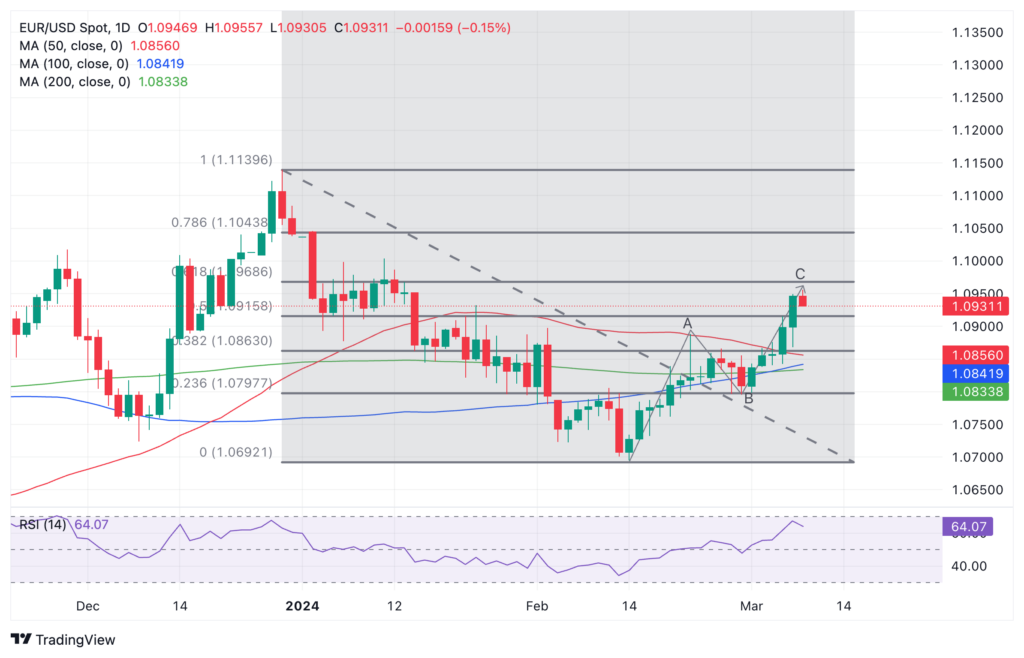
EURUSD recovers after release of US NFP

EURUSD recovers after release of US NFP

– The EUR/USD pair increased after US Nonfarm payrolls data showed a decrease in Average Hourly Earnings and an increase in the Unemployment Rate.
– The US economy added 275,000 jobs in February, more than the 200,000 expected.
– Average Hourly Earnings rose by 4.3% YoY and 0.1% MoM, both below the predicted 4.4% and 0.3%.
– The Unemployment Rate increased to 3.9%, higher than the expected 3.7%.
– This data could lead the Federal Reserve to cut interest rates earlier than anticipated.
– Francois Villeroy de Galua, Governor of the Bank of France and ECB Governing Council member, stated a rate cut in spring is “very likely.”
– Joachim Nagel, Bundesbank President, mentioned the increasing probability of an interest-rate cut before the summer break.
– ECB President Christine Lagarde indicated June as the next key date for reviewing policy on interest rates.
– The EUR/USD is in a short-term uptrend due to the anticipation that the US Fed might lower interest rates sooner than the ECB.
– Technical analysis suggests a tentative short-term uptrend for EUR/USD, with recent signs indicating a possible correction.

Limassol Chamber of Commerce discusses labour shortages with minister

Limassol Chamber of Commerce discusses labour shortages with minister

Labour Minister Yiannis Panayiotou emphasized the importance of collaboration between the government and the business community for economic development, advocating for rational and balanced policies to promote growth and reduce unemployment. He met with the Limassol Chamber of Commerce (Evel) to exchange information and discuss challenges faced by businesses, including worker shortages and slow public service processes. Panayiotou stressed the need for effective public administration and dialogue to find mutually beneficial solutions for economic growth. He acknowledged the necessity of employing workers from abroad due to the economy growing beyond demographic capacities but also highlighted the importance of utilizing local human resources to ensure satisfactory growth in 2024.

Explainer: What you need to know about the 2024 US presidential election

Explainer: What you need to know about the 2024 US presidential election

Fact: Former President Donald Trump is on the cusp of winning the Republican nomination for the 2024 U.S. presidential election.