Farmers, ’ anger spreads in Europe, governments promise help
Farmers, ’ anger spreads in Europe, governments promise help

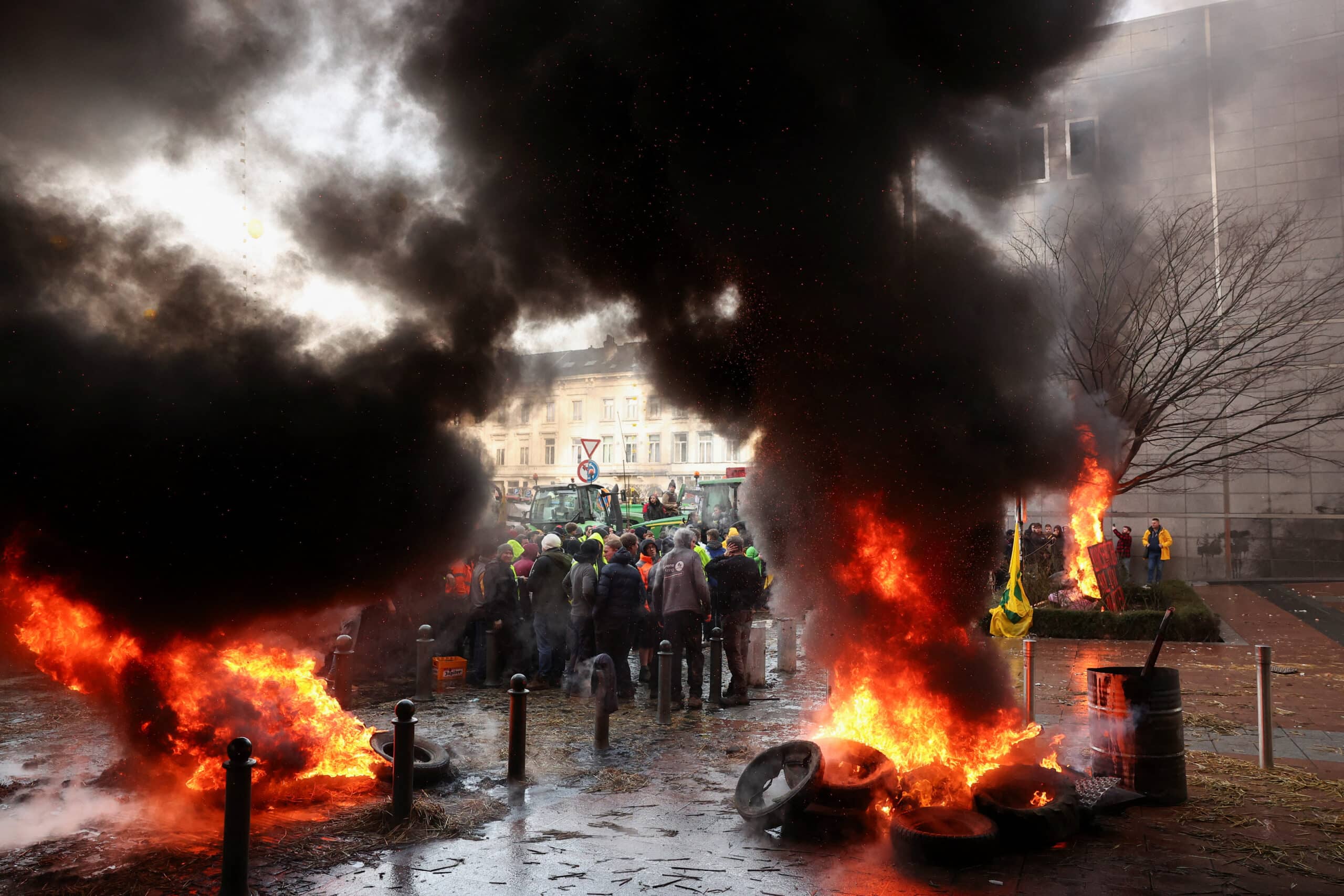
Farmers protested at the European Parliament in Brussels, demanding EU leaders address their concerns about taxes and rising costs. They threw eggs and stones, started fires, and set off fireworks. The protest included farmers from Italy, Spain, and other European countries and coincided with an EU summit. The farmers are also upset about green regulations and cheap imports. Protests were held in various European countries, including Portugal, Greece, and Germany, highlighting tensions over the EU’s climate change policies.

Spanish farmer Jose Maria Castilla, representing Asaja, criticized the European Commission’s regulations. French Prime Minister Gabriel Attal announced measures to support farmers, such as banning cheap imports of products using pesticides forbidden in Europe and ensuring clear labeling of imported food. The European Commission proposed limiting farm imports from Ukraine and relaxing some environmental rules.

The farmers’ crisis was not officially on the EU summit agenda, which focused on aid to Ukraine, but was expected to be discussed. Police used tear gas and water hoses against farmers trying to tear down barriers near the summit. Approximately 1,300 tractors blocked major roads in Brussels, and a statue was damaged. Protests also occurred in Portugal, France, and Greece, with slogans like “No farmers, no food, no future.” Belgian Prime Minister Alexander De Croo and Irish Prime Minister Leo Varadkar expressed the need to address farmers’ grievances, with Varadkar opposing a trade deal with Mercosur. Hungarian Prime Minister Viktor Orban met with farmers and emphasized the need for new leadership representing the people’s interests ahead of the European Parliament elections.

Interest rate cuts likely to take place in 2024, CBC governor says

Interest rate cuts likely to take place in 2024, CBC governor says

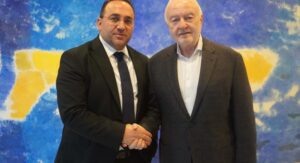
– Finance Minister Makis Keravnos and Cyprus Central Bank Governor Constantinos Herodotou discussed a potential decrease in interest rates by the European Central Bank during 2024.
– They agreed that interest rates are likely to fall before the end of the year, barring unforeseen events.
– Herodotou mentioned the positive trajectory of the Cypriot economy, which was echoed by Keravnos.
– Inflation in Cyprus was at 8.1% in 2022, peaking at 10.6% in July, then falling to 1.9% in December 2023, with a minimal increase expected in January due to the base effect.
– The positive progress in inflation was attributed to monetary policy and targeted support measures.
– Increased uncertainty exists due to geopolitical developments, including attacks on the Suez Canal and the situation in the Middle East.
– Herodotou indicated that interest rate cuts are expected within 2024, but cautioned against reducing them too soon to avoid a resurgence of inflation.
– The majority of Cypriot consumer products are imported from European countries, but the economy is affected by issues such as cruise ship tourism due to regional instability.
– There has been a decrease in the prices of basic products, including fuel, in Cyprus.
– Despite interest rate hikes, a surge in non-performing loans (NPLs) has not occurred, partly due to measures ensuring banks consider borrowers’ repayment capacity and increased savings.
– A new framework for NPLs has seen a positive response from borrowers and includes a stable foreclosure framework with a safety net.
– Banks and credit acquisition companies have restructured £2.4 billion worth of loans in 2023.
– The CBC, in collaboration with the Ministry of Finance, is working on a plan to help smaller banks reduce their NPL ratios, which is currently in its second phase.

EU pushes for higher uptake of two key cancer-preventing vaccines

EU pushes for higher uptake of two key cancer-preventing vaccines

The European Commission is recommending measures for EU countries to increase the uptake of HPV and hepatitis B vaccines to prevent viral infections that can cause cancer. The EU wants member countries to reach 90% HPV vaccination coverage for girls by 2030 and increase the rate for boys. Some countries have vaccination rates as low as 1%. To achieve this, the EU recommends providing free or fully reimbursable vaccination, setting targets for boys, and improving communication and access. The authorized HPV vaccines in the EU are made by GlaxoSmithKline and Merck & Co.

Cyprus aiming for 80,000 Swiss tourists in 2024

Cyprus aiming for 80,000 Swiss tourists in 2024

The Deputy Ministry of Tourism of Cyprus anticipates an increase in tourist arrivals from Switzerland, expecting to reach 80,000 visits this year. Deputy Minister of Tourism Kostas Koumis had meetings in Zurich, where Swiss tourist arrivals to Cyprus in 2023 were 73,000, a 20% increase from 2022. Koumis discussed the Swiss market’s progress, visitor satisfaction, special tourism forms, and air connectivity between Cyprus and Switzerland. He also gave an interview to a Swiss tourism magazine. Koumis highlighted the high average spending of Swiss visitors compared to the overall average. He suggested that with available airline seats, an increase in visitors is feasible, potentially reaching the highest performance in two decades for the Swiss market in Cyprus.

The Swiss Federal Statistical Office reported that in 2022, residents of Switzerland averaged 2.6 trips with overnight stays and eight day trips, with 40% of overnight trips and 92% of day trips occurring within Switzerland. The most visited destinations were Italy (13%), Germany (10%), and France (8%). A quarter of all trips were to other European countries, and 4% were to destinations outside of Europe. Visits to Southeast Europe increased by 0.2% to 1.2%, and to Southwest Europe by 0.5% to 1.6%, compared to 2021.

Additionally, Koumis held discussions in Brussels to promote tourism from Belgium, focusing on increased air travel and promotional programmes.

Cyprus slides in global Corruption Perception Index

Cyprus slides in global Corruption Perception Index

– Cyprus ranks 49 out of 180 countries in the latest Corruption Perception Index (CPI) released by Transparency International.
– Cyprus was awarded a score of 53 points in the 2023 CPI, which is a slight increase from 52 in 2022 but the same as in 2021.
– This score marks Cyprus’s lowest point since 2012, indicating a trend of increasing corruption levels.
– Denmark, Finland, and New Zealand are the top-ranked countries in the CPI as the least corrupt.
– Western European countries are showing a decline in the CPI, suggesting a need for stronger anti-corruption measures.
– Hungary, Romania, and Bulgaria are the lowest-ranked countries in the Western Europe region.
– Cyprus has satisfactorily dealt with nine out of 16 recommendations from the latest Greco report on tackling corruption.
– One recommendation not implemented by Cyprus concerns the independence of prosecutors.
– A bill regarding the independence of prosecutors is currently before the Cypriot parliament.

Before Friday's Cabinet, the decision on Great Sea Interconnector

Before Friday's Cabinet, the decision on Great Sea Interconnector

The fact described in the text is that there is a proposal for the interconnection of the national electricity transmission networks of Cyprus, Israel, and Greece. The project, called Great Sea Interconnector, aims to connect the networks through underwater cables with a capacity of 2,000 MW. The first phase will involve the electrical connection between Cyprus and Crete, followed by a second phase connecting Cyprus and Israel. The project has received positive evaluation and interest from international investors, including the United Arab Emirates' Investment Fund (TAQA). The total cost of the project is estimated to be around 1.9 billion euros, with funding sought from both the market (approximately 1.2 billion euros) and the European Union's Connecting Europe Facility (657 million euros).

Nine cities candidates for headquarters of the European Anti-Money Laundering Authority

Paris, Brussels, Frankfurt, Dublin, Madrid, Rome, Riga, Vilnius, and Vienna are nine cities in Europe that have been nominated to host the European Authority against money laundering and terrorism financing. French standards in combating money laundering are among the highest in the world. The French delegation will emphasize the limited number of EU employees living and working in France compared to other countries. The European Authority for money laundering is expected to employ 250 staff members initially.

Commissioner Kyriakides to host European conference on cancer

Stella Kyriakides, the EU Commissioner for Health, will lead a conference in Brussels on the European Union’s strategies for battling cancer. The conference, titled “Europe’s Beating Cancer Plan: Joining Forces,” will include participants such as cancer patients, healthcare experts, and delegates from global entities like the World Health Organisation. The agenda will cover topics such as collaborative efforts under the EU’s Cancer Plan, care for pediatric cancer patients, high-quality cancer screenings, access to psychosocial oncology services, international partnerships, and reducing health disparities. The conference will be accessible online and marks the third anniversary of Europe’s Beating Cancer Plan. Virtual contributions will be made by Ursula von der Leyen and Roberta Metsola, and keynote speeches will be given by Margaritis Schinas and Stella Kyriakides. The event will conclude with remarks from Frank Vandenbroucke.

IMF says global ‘soft landing’ in sight, lifts 2024 growth outlook

The International Monetary Fund (IMF) has upgraded its forecast for global economic growth, citing faster-than-expected easing of inflation. The IMF’s chief economist, Pierre-Olivier Gourinchas, stated that a “soft landing” was in sight, but overall growth and global trade still remained lower than the historical average. The IMF forecast global growth of 3.1% in 2024, up from its previous forecast of 2.9%, and expected global trade to expand by 3.3% in 2024. However, risks such as geopolitical tensions in the Middle East and attacks in the Red Sea could disrupt commodity prices and supply chains. The IMF also warned that delays in fiscal consolidation and the potential violation of global trade rules by certain countries could impact economic activity.