Dutch nationalist Wilders says deal on right-wing government is very close
Geert Wilders, a Dutch nationalist, is close to reaching an agreement with his prospective right-wing government partners almost six months after his election victory.

Spain’s Socialists won the biggest share of the vote in Sunday’s Catalan elections, dealing a serious blow to more than a decade of separatist governance in Catalonia. The Socialists had 42 seats in the 135-seat chamber, while hardline separatist party Junts was in second place with 35 seats and the more moderate separatist party ERC had 20 seats. The result is an existential threat to separatist governance in Catalonia, which led an illegal independence referendum in 2017. Separatist parties do not have enough seats to form a coalition government, and there is a risk the vote may need to be repeated. Separatist sentiment in Catalonia has decreased, with the pro-independence movement losing energy and unity in recent years.
South Africans will vote in a national election on May 29 with uncertainty about the outcome, as polls suggest the African National Congress may lose its majority after 30 years in power. Key issues include high unemployment rates, sluggish economic growth, power cuts, corruption scandals, high rates of violent crime, and rising anti-immigrant sentiment. The government is working to address these issues, with a focus on job creation, economic growth, and tightening immigration laws.
Fact: Verbal and physical attacks on politicians in Germany have more than doubled since 2019, with the Greens party reporting the highest number of incidents last year.
Catalans are voting in a regional election between an exiled separatist politician, Carles Puigdemont, and the Socialist Party led by Salvador Illa. Puigdemont, who fled Spain after a failed independence bid in 2017, is vowing to resurrect the bid if elected. Opinion polls predict a lead for the Socialists, with the possibility of forming a coalition government due to the likelihood of no party reaching a majority. If no agreement is reached by August, a repeat election would take place in October.
German politicians have been experiencing a surge in physical and verbal attacks, with 22 assaults reported so far in 2024 compared to 27 in all of 2023. The Green party has been the most targeted, with 1,219 incidents reported last year, followed by the far-right Alternative for Germany (AfD) party with 478 incidents. The rise in confrontations is attributed to the divisive rhetoric of populist politics, affecting the overall mood and safety of politicians. The attacks have led to concerns about the impact on election outcomes and have prompted some politicians to take precautions, such as avoiding publicizing campaign events and increasing security measures.
The Slovenian government has initiated the procedure for the recognition of a Palestinian state as a way to help end the conflict in Gaza. This decision was made to encourage negotiations and speed up dialogue in the United Nations for a ceasefire and a two-state solution. Other European Union member states are also considering recognizing a Palestinian state, with Slovenia aiming to complete the recognition process by June 13 at the latest. Israel has criticized this move, calling it a “prize for terrorism” that could hinder peaceful resolution to the conflict.
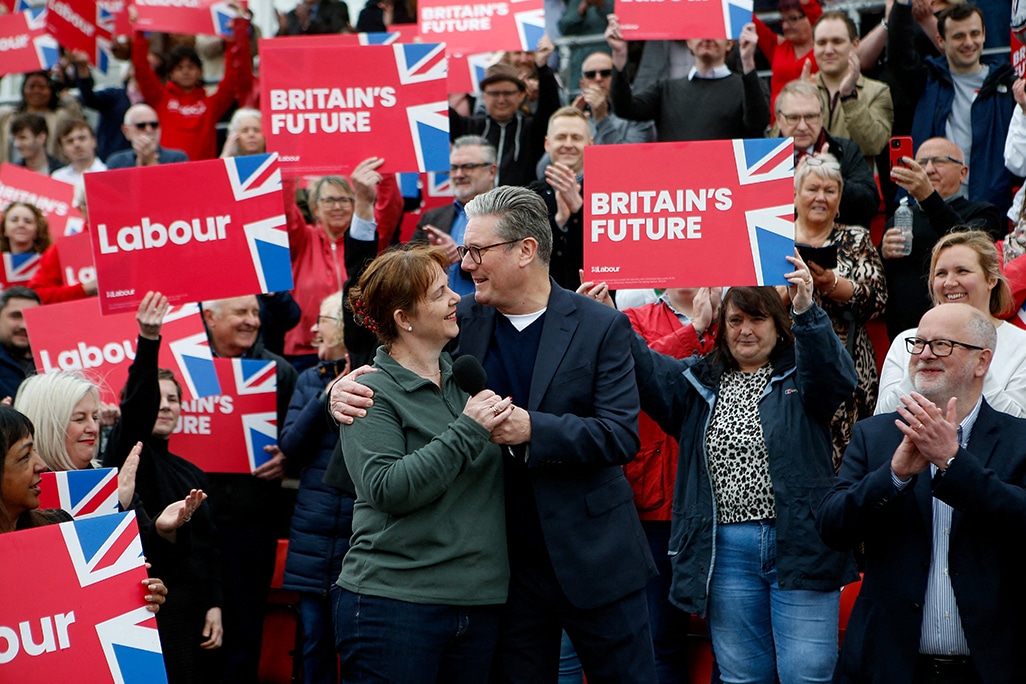
Fact: Britain’s opposition Labour Party has increased its poll lead over Prime Minister Rishi Sunak’s Conservatives to stand 30 points ahead, according to a YouGov poll for the Times newspaper.
John Swinney was elected as the new leader of the Scottish National Party (SNP) and is set to replace Humza Yousaf as Scotland’s first minister.
A proposal to reform San Francisco’s business tax formula is being considered for approval by voters in November. The proposal would modify the gross receipts tax to focus on a company’s sales instead of its on-site headcount, potentially leading to tax cuts for small businesses and making it more attractive for large companies to keep their workers in the city. The plan is expected to be revenue neutral over time, with initial declines in business tax revenue before increases in the following years. The proposal would also raise the threshold for exemption from gross receipts taxes for small businesses. The effort to reform the tax structure has gathered momentum over the past year and has involved major San Francisco employers, labor unions, and other stakeholders in negotiations. Labor unions are not expected to actively oppose the measure’s passage.