Economic growth slows, to pick up from 2025
Economic growth slows, to pick up from 2025

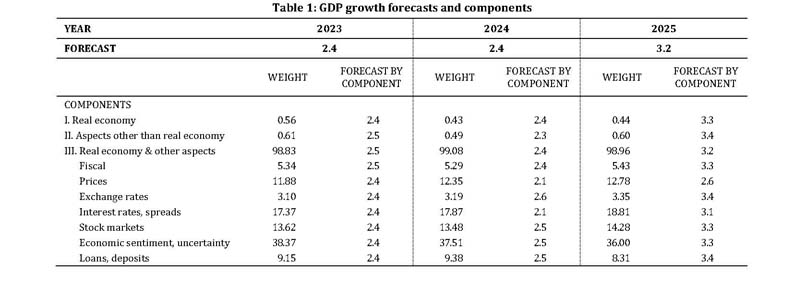
The University of Cyprus has estimated that real GDP growth in Cyprus will slow from 5.1% in 2022 to 2.4% in 2023. Economic growth is projected to remain at 2.4% in 2024 and improve to 3.2% in 2025. The forecast for 2023 has remained unchanged, but the forecast for 2024 has been revised down by 0.4 percentage points. The slowdown in growth in 2023 is attributed to tightening monetary policy and geopolitical turmoil. Despite the slowdown, economic activity and the labor market in Cyprus have remained resilient, and inflation has gradually decelerated. Inflation is projected to decrease from 3.5% in 2023 to 2.1% in 2024 and 2.0% in 2025. Risks to the growth outlook are tilted to the downside, while risks to the inflation outlook are skewed to the upside due to increased geopolitical turmoil.


Christodoulides reveals 14 CBMs for Turkish Cypriots

Christodoulides reveals 14 CBMs for Turkish Cypriots

President Nikos Christodoulides has announced a set of confidence-building measures aimed at improving the daily lives of Turkish Cypriots. One of the main measures is to grant citizenship to the children of a Turkish Cypriot and a Turkish parent. Other measures include enhancing the ‘Green Line Trade’ facility and implementing various social and economic initiatives. These measures are seen as significant gestures towards the Turkish Cypriots and could help in resolving the Cyprus problem. However, Turkish Cypriot leader Ersin Tatar has described the measures as “full of traps.” The measures will be implemented in line with national law, international law, and the European Union (EU) acquis.

US inflation opens door to March Fed rate cut

US inflation opens door to March Fed rate cut

The US inflation, income, and spending data released on Friday were generally in line with expectations. Spending increased by 0.7%, surpassing the expected 0.5%. This suggests that the US consumer and economy are in good shape. The inflation data released alongside the spending data indicates that inflationary pressures are not increasing significantly. Oil prices remained flat after reaching a two-month high, and gold prices remained above ,000. The data supports the case for rate cuts in March, but steady prices prevent excessive optimism.

February brings German consumer sentiment back in doldrums

February brings German consumer sentiment back in doldrums

German consumer sentiment is projected to decline in February, with the consumer sentiment index dropping to -29.7 points from -25.4 the previous month, contrary to analysts’ expectations of a slight increase to -24.5. The willingness to save among consumers reached its highest level since August 2008, contributing to the fall in overall sentiment, alongside lower income expectations and a reduced propensity to buy. Factors such as crises, wars, and high inflation are impeding any significant improvement in sentiment. The GfK institute and the Nuremberg Institute for Market Decisions (NIM) conduct a monthly survey of around 2,000 consumers to produce these findings. The consumer climate indicator is used to forecast the progress of real private consumption in the following month, with a reading above zero indicating year-on-year growth and below zero indicating a decline. A one-point change in the indicator corresponds to a 0.1 percent year-on-year change in private consumption. The “willingness to buy” indicator assesses consumer opinions on purchasing major items, while the income expectations sub-index gauges household financial outlook over the next 12 months. The business cycle expectations index reflects the general economic situation assessment for the coming year.

Turkish Cypriot butchers protest as consumers buy from Republic

Turkish Cypriot butchers protest as consumers buy from Republic

Turkish Cypriot butchers are experiencing a loss of customers as consumers opt to buy cheaper meat in the Republic of Cyprus. The butchers held a protest at the north’s slaughterhouse, where they slaughtered two lambs. They are urging the northern government to take urgent action to allow meat to be sold at competitive prices. The butchers’ association has highlighted that the high price of livestock in the north is causing economic difficulties for vendors, leading to potential bankruptcy. They are unable to sell meat, which leads to waste as the unsold meat spoils, and as a result, animal slaughter rates have dropped significantly. The butchers have expressed dissatisfaction with the government’s inaction to address the crisis, which is affecting their livelihood and the broader economy, including production and tourism sectors. They warn that if the situation does not improve, it could lead to more severe consequences.

Bank deposits see increase

Bank deposits see increase

In December, total deposits in the banking system increased by €346 million, reaching €52.2 billion. Total loans also increased by €284.2 million, reaching €24.8 billion. The system liquidity, which is the difference between deposits and loans, was set at €27.4 billion. Deposits from residents of Cyprus increased by €388 million, with household deposits increasing by €461 million. Deposits from domestic non-financial corporations decreased by €252 million. Deposits from other domestic sectors increased by €179 million. Loans to residents of Cyprus increased by €132.9 million, with loans to households increasing by €99 million and loans to non-financial corporations increasing by €54.5 million. Loans to other domestic sectors decreased by €20.6 million.

ECB,  holds rates at 4%, investors need vigilance

ECB,  holds rates at 4%, investors need vigilance

The European Central Bank has decided to keep interest rates unchanged at 4% for the third consecutive meeting. The bank is focused on bringing inflation down to 2% and is committed to maintaining interest rates at their current levels for a long duration. Investors are advised to pay attention to the ECB’s messaging and not be swayed by market hype and speculation. The decision to hold interest rates steady is part of a broader global context where central banks are closely monitoring economic indicators and working towards economic stability.

Strong batch of US data, ECB gives little away

Strong batch of US data, ECB gives little away

The US economy is performing well, with GDP data for the fourth quarter exceeding expectations. The European Central Bank (ECB) has left interest rates on hold at 4% and has not provided clear guidance on when rates will start falling. The euro has drifted lower after the ECB press conference and US data, but it has not broken out of its recent trading range.

Finance Minister states his support for CoLA

Finance Minister states his support for CoLA

The Minister of Finance has issued a statement in response to trade unions’ reactions to his statements on productivity and competitiveness in the Cypriot economy. He supports the cost-of-living allowance and clarifies that his previous statements were in favor of it. He emphasizes that he does not align himself with any side in the negotiation process for the allowance, but only with the interests of the Cypriot people and a healthy and competitive economy. He intends to encourage social partners to consider productivity, competitiveness, and income distribution in the economy.

German business activity deteriorates in January

German business activity deteriorates in January

Germany’s economic downturn worsened in January, with both manufacturing and services activity contracting. The HCOB German Flash Composite Purchasing Managers’ Index (PMI) fell to 47.1, below economists’ forecast of 47.8. The manufacturing PMI rose to 45.4, but still in contraction territory. Business activity in the services sector fell to a 5-month low of 47.6. The survey showed continued weakness in demand but limited impact on the labor market.