Cyprus banks to maintain stability, but lower profits, says Moody, ’s

Cyprus banks to maintain stability, but lower profits, says Moody, ’s

– Risks associated with loans for Cypriot banks are expected to decrease due to economic growth, declining inflation, and unemployment rates.
– Moody’s predicts a decline in bank profits from recent highs.
– A gradual decrease in net interest margins is anticipated due to rising deposit costs and falling interest rates, influenced by competition and high levels of private sector debt.
– Stricter loan criteria and loan restructuring efforts are improving loan quality and reducing problematic loans.
– Asset quality risks from foreclosed properties are diminishing, supported by a strong real estate market.
– The banking sector in Cyprus is characterized by a low loan-to-deposit ratio and ample liquidity reserves.
– Cyprus’ GDP is forecasted to grow by 2.8% in 2024 and 3.2% in 2025-27, outpacing the euro area by 0.8% in 2024.
– Economic growth is supported by diversification in the services sector and significant foreign direct investment projects.
– Moderate growth in the loan portfolio is expected due to the banking system’s saturation, high private sector debt, and elevated interest rates.
– Monetary policy is expected to remain restrictive, even with interest rate reductions by the European Central Bank.
– The NPE ratio is expected to decrease below 3% this year.
– The proportion of foreclosed assets relative to bank equity is decreasing, supported by the real estate market.
– Capital risks are declining, with banks completing risk release and balance sheet restructuring.
– The Common Equity Tier 1 ratio for assessed banks increased to 18.8% at the end of 2023.
– Moody’s assessment focuses on Cyprus’ two largest domestic banks, Bank of Cyprus and Hellenic Bank, which represent a significant portion of the banking system’s assets.
– The weighted average Baseline Credit Assessment of the two major banks is ba2, with a weighted average asset-based deposit rating of Baa3.

UK house prices fall by 0.6 per cent in annual terms in January

UK house prices fall by 0.6 per cent in annual terms in January

British house prices fell by 0.6 percent on an annual basis in January, after a revised 2.2 percent decrease in December, according to the Office for National Statistics (ONS). Other data showed house prices rose in January as demand increased following a decrease in mortgage costs and weaker inflation. A slowdown in British consumer price inflation led to increased expectations of an interest rate cut by the Bank of England in August. The ONS reported that private rents rose by 9.0 percent in the year to February, the largest increase since records began in 2015, up from 8.5 percent in the 12 months to January.

Euro-Dollar weakens ahead of Fed, Lagarde cites lower inflation

Euro-Dollar weakens ahead of Fed, Lagarde cites lower inflation

The EURUSD pair declined to the lower 1.0800s after European Central Bank (ECB) speakers, including President Christine Lagarde and Bank of Ireland Governor Gabriel Makhlouf, cited lower inflation. Lagarde mentioned a decrease in wage inflation and stated that the ECB is closely monitoring this before deciding on future policy moves. Lower inflation could lead to the ECB cutting interest rates, negatively affecting the Euro and the EURUSD pair. Lagarde noted that average wage growth for 2024 fell from 4.4% to 4.2% between the ECB’s January and March meetings. She mentioned the need for more evidence of receding inflation but suggested that rate hikes could be dialed back in June if data aligns with current expectations. The ECB is divided into two camps regarding the timing of interest rate decisions. ECB Vice President Luis de Guindos, preferring to wait until the June meeting, highlighted that services inflation remains too high. The Federal Reserve is expected to complete its March policy meeting without changing interest rates but may revise its quarterly forecasts and statement, potentially affecting the US Dollar valuation. Speculation exists that the Fed might adjust its economic forecasts in the Summary of Economic Projections (SEP) and the “dot plot,” possibly revising down the forecasted rate cuts in 2024 due to persistent inflationary pressures.

The Fed, the whole Fed and nothing but the Fed

The Fed, the whole Fed and nothing but the Fed

– The USD Index (DXY) reached three-week highs past the 104.00 mark on Tuesday, despite a decline in US yields.
– The Federal Reserve’s interest rate decision and the FOMC Economic Projections, along with Chair Jerome Powell’s press conference, are scheduled for Wednesday.
– The EURUSD pair fell to multi-week lows near the 1.0830 region, testing the critical 200-day SMA.
– ECB’s Christiane Lagarde is set to speak on Wednesday, and the European Commission will release its flash Consumer Confidence gauge.
– The GBPUSD pair moved beyond 1.2700 towards the end of the NA session on Tuesday after reversing an earlier pullback to the 1.2670 zone.
– The UK will report the Inflation Rate on March 20.
– The USDJPY pair approached the 151.00 mark, near 2024 highs, due to increased selling pressure on the yen following the BoJ rate hike.
– The AUDUSD pair approached the 0.6500 support level for the fourth consecutive session, influenced by a stronger USD and the RBA’s dovish stance. The RBA’s Consumer Inflation Expectations are due on March 20.
– WTI oil prices surpassed .00 per barrel, reaching four-month highs, driven by geopolitical factors and anticipated stronger demand.
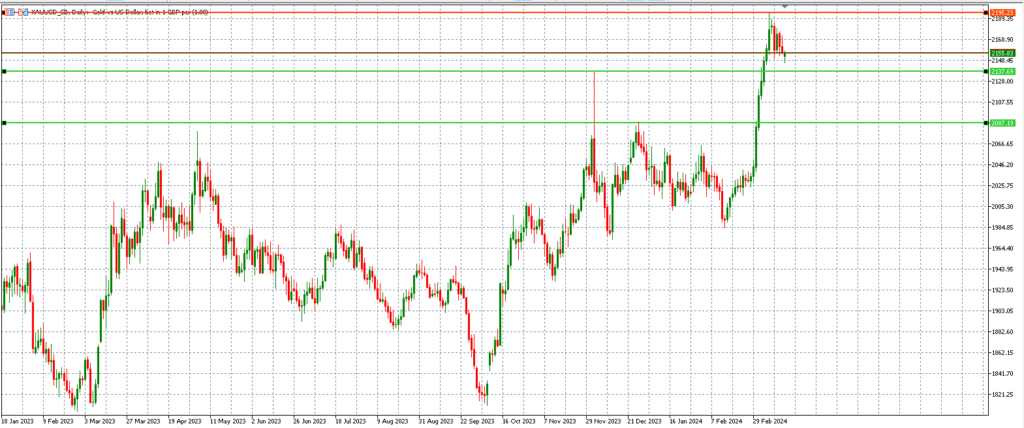
– Gold prices saw modest losses around the ,150 per troy ounce zone, affected by the stronger Dollar and lower US yields.
– Silver prices dropped for the second consecutive session after reaching highs near .50 per ounce on Friday.

Another pivotal week

Another pivotal week

– This week is pivotal for investors and traders trying to gauge the Federal Reserve’s next move in terms of its monetary policy.
– Adjustments have been made in the Fed rate cut expectations by looking at the US equity markets or fixed income markets.
– Wall Street giants have scaled back their rate cut bets for this year while being more optimistic for 2025.
– Controlling inflation and navigating the economy post-COVID-19 crisis have been challenging tasks for the Fed.
– Recent data on producer prices and consumer prices raised concerns among investors and traders about inflation plateauing and becoming stickier than anticipated.
– The Fed Chairman indicated that the nature of inflation and its measurement have been permanently impacted by COVID, suggesting a reevaluation of the 2% inflation target.
– Consumer prices increased by 0.4% for the month and by 3.2% from a year ago, while producer prices jumped by 0.6% on the month, double the Dow Jones estimate.
– The Fed is expected to keep the rate at its current level of 5.50% in the upcoming monetary policy announcement.
– The sticky nature of inflation reduces the incentive for the Fed to take aggressive measures to lower interest rates.
– Goldman Sachs expects the Fed to cut rates three times this year, down from an earlier expectation of four times.
– The possibility of Donald Trump returning to office could influence the Fed’s rate cut decisions, as he favors lower interest rates.
– US stock indices have experienced volatility, partly due to sell-offs among some major stocks.
– Gold recorded its first negative week in over three weeks, with its current record high being about shy of ,200. The immediate support level for gold stands at 37, with the next support level at 87, and resistance at 95.

Oil prices edge lower but set to end week over 3 per cent higher

Oil prices edge lower but set to end week over 3 per cent higher

Oil prices were lower on Friday but expected to gain over 3% for the week due to the International Energy Agency raising its 2024 oil demand forecasts and a decline in US stockpiles. Brent crude futures were down to .83 a barrel, and US West Texas Intermediate crude was at .70. The IEA increased its 2024 oil demand forecast by 110,000 barrels per day (bpd) to a rise of 1.3 million bpd, citing disruptions from Houthi attacks on Red Sea shipping and forecasting a slight supply deficit if OPEC+ maintains output cuts. US crude stockpiles fell unexpectedly as refineries increased processing and gasoline demand rose. China’s central bank kept a key policy rate unchanged, focusing on currency stability, while signs of slowing economic activity in the US were observed, with no expected Federal Reserve interest rate cuts before June.

Japan union group announces biggest wage hikes in 33 years, presaging shift at central bank

Japan union group announces biggest wage hikes in 33 years, presaging shift at central bank

Japan’s largest companies have agreed to a 5.28% wage increase for 2024, the largest in 33 years, according to the country’s largest union group. This development is seen as a sign that the Bank of Japan may soon end its decade-long stimulus program, especially considering the bank’s eight years of negative interest rate policy. The wage increase exceeds expectations and comes amid annual wage negotiations, which are crucial for the Bank of Japan’s policy decisions. Policymakers hope the wage hikes will boost household spending and support sustainable economic growth. Workers had initially requested a 5.85% increase. The wage hikes are expected to result in positive real wages by April-June 2024. Rengo, the trade union group representing about 7 million workers, aimed for more than 3% increases in base pay. Rising income inequality, inflation, and labor shortages were cited as reasons for the significant wage increase, with part-time workers expected to see a 6% increase this fiscal year. The government hopes these wage hikes will benefit smaller and medium-sized firms, which make up 99.7% of all enterprises. However, wage increases for smaller companies are expected to be lower. Among smaller delivery companies, only 57% plan to raise wages in the upcoming fiscal year. Despite wage increases, real wages have fallen for 22 consecutive months due to inflation not keeping pace. Toyota Motor announced its largest pay increase in 25 years, indicating a strong stance in labor negotiations. The central bank may end negative interest rates as early as its next meeting on March 18-19, influenced by the wage increases and chronic labor shortages in Japan. Prime Minister Fumio Kishida encourages companies to raise wages to combat deflation and improve Japan’s wage growth compared to other OECD countries. The annual pay negotiations, known as “shunto” or “spring labor offensive,” are a key aspect of Japanese business culture, emphasizing collaborative labor-management relations.

Bank of England set to play for time before first rate cut

Bank of England set to play for time before first rate cut

The Bank of England is expected to maintain uncertainty about when it will start reducing interest rates, awaiting clearer evidence that inflation pressures are diminishing. Despite other central banks moving towards cutting borrowing costs post-COVID pandemic and inflation projected to decrease to the 2% target soon, the BoE has labeled its high rates as “under review.” Governor Andrew Bailey expressed a cautiously optimistic outlook, noting inflation expectations appear controlled and concerns over a price-wage spiral are lessening. However, Bailey indicated no rush to lower the Bank Rate from its 16-year peak of 5.25%, citing labor market data uncertainties and geopolitical risks. In February, the decision to keep the Bank Rate steady was supported by six rate-setters, with two advocating for an increase and one for a reduction. Analysts anticipate a similar 6-2-1 vote split in the next decision, potentially influenced by upcoming inflation data. The BoE forecasts inflation to slow to 2% in the second quarter following a decrease in regulated energy costs but expects a rise to almost 3% later in 2024. Inflation reached a high of 11.1% in October 2022. The central bank remains concerned about the risk posed by fast-growing wages, with Britain’s minimum wage set to increase by nearly 10% and employers offering pay settlements of about 5% since the start of 2024. Former BoE deputy governor Charlie Bean highlighted that Britain’s pay growth is roughly double the level consistent with 2% inflation. The BoE is seen as moving more slowly towards rate cuts compared to other central banks, with the British economy showing signs of recovery from a short recession. Finance minister Jeremy Hunt announced tax cuts to moderately boost consumers. The European Central Bank and the US Federal Reserve are contemplating rate cuts, potentially placing the BoE behind. Economists at HSBC predict inflation could drop to as low as 1.2% in May and June before rising later in the year, challenging the BoE’s communication on maintaining its current stance. A Reuters poll shows economists mostly expect rate cuts to begin in the third quarter, with 40% anticipating a move in the second quarter. Investors do not fully expect a quarter-point cut until August. The BoE’s March monetary policy decision will be announced without a press conference, as no new economic forecasts are due to be published.

Hellenic rolls out new fixed-deposit offering

Hellenic rolls out new fixed-deposit offering

Hellenic Bank has introduced a new product called the “18-month Euro Fixed Deposit,” designed for both retail and corporate customers. This product offers an 18-month fixed-term deposit with a 1.5 percent interest rate, applicable for amounts of €20,000 and above, and is available in euros. Customers have the option to either automatically renew the deposit upon maturity or have the interest paid into their account. This product offers a higher interest rate compared to other deposit products by Hellenic Bank and is available for creation online through Online Banking for individual customers.

Euro awaits US data, ECB speakers

Euro awaits US data, ECB speakers

The EURUSD exchange rate was trading in the mid 1.0900s after reaching a peak at 1.0981 the previous week. Upcoming data releases and events are expected to introduce some volatility to the Euro-dollar pair. In the US, upcoming factory gate inflation and Retail Sales data could influence expectations regarding the Federal Reserve’s timeline for interest rate cuts, which is a significant factor for the US Dollar. Economists anticipate a decrease in Core PPI to 1.9% year-over-year in February from 2.0% in January, with a month-on-month forecast showing a 0.2% increase compared to the 0.5% increase the previous month. The headline Producer Price Index (PPI) is expected to show a 1.1% year-over-year gain, up from 0.9% in January, and a 0.3% month-on-month gain, consistent with the previous month. This data is a crucial indicator for CPI inflation, as increases in wholesale costs are typically passed on to consumers. Market participants are betting on a 67.2% probability of the Fed cutting interest rates in June, according to the CME FedWatch Tool. US Treasury Secretary Janet Yellen stated that it seems unlikely for interest rates to return to pre-COVID-19 levels and deemed the interest rate projections in President Biden’s budget plan as “reasonable.” In Europe, several ECB officials are set to speak, potentially providing insights into whether interest rates will be cut in April or June. If inflation remains high, interest rates are likely to stay elevated, supporting the Euro. ECB Governing Council member Francois Villeroy de Galhau indicated a preference for an April rate cut, while Bank of Austria Governor Robert Holzmann and ECB President Christine Lagarde suggested a June timeline for revisiting rate policies. The timing of ECB rate cuts could impact the Euro and EURUSD exchange rate. After recent US inflation data, a calmer period is expected in the EURUSD pair ahead of the next week’s Federal Reserve meeting.