An area equal to one and a half times the size of Spain was lost in the American continent. Globally, 6.5 billion were released from the fires. tons of CO2
Deadly and uncontrollable: in 2023, forest fires destroyed nearly 4 billion hectares of forest, killed more than 250 people and caused the release of 6.5 billion tons of carbon dioxide into the atmosphere.
Fires of historic proportions in Canada
The Americas has experienced a record-breaking wildfire season this year, with nearly 800 million acres burned by Dec. 23, more than one and a half times the size of Spain, 100 million more than the 2012-2022 annual average of on the same date, according to the Global Wildfire Information System (GWIS).
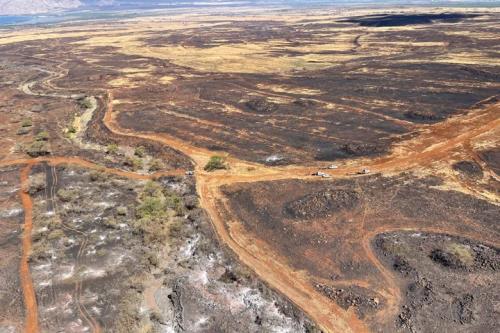
The biggest disaster occurred in Canada, where 180 million hectares of forest burned this year.
They were fires fueled by drought and heat caused by climate change and were "uncontrollable" as "fighting tactics proved ineffective," Pauline Villen-Carlotti, a PhD in geography and fire expert, told AFP.
"We are no longer able to deal with them, in today's conditions, with human means, hence the importance of acting rather in advance, in prevention, rather than after the fact, in combat and extinguishment," he continues.
What's left of the Fort Creek fire in Canada
VIA ASSOCIATED PRESS
A killer year
A total of 97 dead and 31 missing in the August fires in Hawaii, 34 dead in Algeria, 28 in Greece… The year was the deadliest of the 21st century, according to Catholic University's Emergency Events Database (EM-DAT) of Louvain, with more than 250 dead.
"This is an excessive mortality that risks increasing in the coming years," with fires "coming dangerously close to cities," points out Pauline Villen-Carlotti. In August, the tourist town of Lahaina in Maui, Hawaii, was almost completely destroyed by fire.
And this year, in addition to the zones that are generally exposed, such as the Mediterranean basin (Greece, Italy, Tunisia, Algeria), North America or Australia, other regions, which had so far been spared, such as Hawaii or Tenerife, suffered disasters – increasing the number of people at risk and affecting the most vulnerable populations.
Fire in Rhodes VIA ASSOCIATED PRESS
6,000,000 tons of carbon dioxide
The more fires multiply, the less time vegetation has to regrow and the more forests can lose their ability to absorb carbon dioxide. "According to recent studies, wildfires reduce carbon storage by about 10%," explains Solène Tirketti, researcher at LATMOS (Laboratoire Atmosphères, Milieux, Observations spatiales).
In addition, when trees burn, they suddenly release all the carbon dioxide – a gas that causes the greenhouse effect – that they had stored into the atmosphere.
However, the impact is relative: since the beginning of the year, wildfires have released about 6.5 billion tons of carbon dioxide, according to the Global Wildfire Information System (GWIS), compared to 36.8 billion tons from the use of fossil fuels (oil, gas, coal…) and cement.
In general, about 80% of the carbon created by wildfires is then reabsorbed by vegetation that grows back the following season. The remaining 20% instead contributes to enhancing the accumulation of carbon dioxide in the atmosphere, fueling the rise in temperature in a kind of vicious cycle.
The smoke from the fires in Canada reached New York
VIA ASSOCIATED PRESS
Direct health impact
In addition to carbon dioxide, forest fires and fires in areas with low vegetation release a whole range of pathogenic particles, from carbon monoxide to a whole range of other gases or aerosols (ashes, soot…).
"These emissions change air quality enormously, hundreds of kilometers away in the most severe fires," says Solenn Tirketi, pointing to "an immediate health impact" that adds up to "the destruction of ecosystems, goods and infrastructure."
According to a study published in September in the journal Nature, the populations of the poorest countries, primarily in central Africa, are much more exposed to air pollution caused by these fires than those of developed countries.
The sky in Attica is red from fires in the surrounding areas
VIA ASSOCIATED PRESS
The special case of Africa
Africa is the continent in which the largest areas have burned since the beginning of time (almost 2.120 billion hectares), but for Pauline Villen-Carlotti we should not "give too much weight to these African fires", because this number does not reflect "large forest fires".
These are rather small "agricultural fires", "a traditional practice which does not particularly harm the forests because the fires are controlled" and is applied in a circular way, says the expert.
They have an impact on the local flora and fauna, but in the medium term "the trees will regrow generally allowing a renewal" of the vegetation, an increase in plant diversity, he adds.
The possibility of regeneration of burnt surfaces really depends on the frequency of fires in the same piece of land and on the intensity of the fires.
Sources: AFP, APE BEE, HuffPost Greece