The first phase of pre-selection of the top two proposals will be completed in December 2024 and the second and final phase of selection will be completed at the end of 2025
Taking over the institution of European Capital of Culture creates huge challenges and opportunities both for the city that will receive the title and for the member state itself, said the Deputy Minister of Culture Vassiliki Kassianidou.
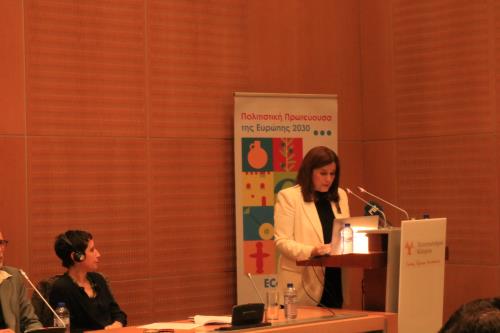
Mrs. Kassianidou was speaking during an information session regarding the institution "Cultural Capital of Europe for the year 2030" organized on Monday by the Deputy Ministry of Culture at the Campus, in Nicosia. During the conference, which was addressed to the candidate cities of Cyprus, the application process was explained and questions from representatives of the candidate cities were answered.
During the first part of the conference, the Deputy Minister of Culture, Vasiliki Kassianidou, said that the institution of the European Capital of Culture "is today a wonderful tool, through which cities tirelessly explore new ways to highlight their culture and build trust between communities across our continent."
It is therefore obvious, he continued, "that this institution, in addition to contributing to cultural development and creation, through synergies of cultural bodies from the international arena, contributes equally significantly to the improvement of the cultural infrastructure of the city, turning it into an attractive cultural destination".
"Culture is of central and increasing importance for the European, but mainly for the local development and economy", emphasized the Deputy Minister of Culture, underlining that "taking over the institution of the European Capital of Culture creates huge challenges and opportunities both for the city that will get the title as much as for the member state itself".
As he said, "the city that bears the title of European Capital of Culture through the activities, highlights its character, its traditions and its modern creativity, while at the same time perspectives of recognition and promotion, development and progress are created for it".
As Ms. Kassianidou explained, the title of European Capital of Culture 2030 will be awarded to a city in Cyprus, to a city in Belgium, but also to a city in a third country, which is a candidate country or a potential candidate for EU membership.
He added that for the title of European Capital of Culture 2030, the Deputy Ministry of Culture, as the competent Administrative Authority, is responsible, in close cooperation with the European Commission, for conducting the competition, the selection of the city, and for all other related procedures.
The process, as the Deputy Minister of Culture said, includes two phases. The first phase of pre-selection of the top two proposals will be completed in December 2024. The second and final phase of selection, he added, will be completed at the end of 2025, when it will be announced which city has managed to win the title for the year 2030.
"As recently announced, by decision of the Council of Ministers, the state will give this city the amount of €6.5 million as a contribution for the operating costs required to carry out its program," noted Mrs. Kassianidou, adding that the city, subject to certain conditions, will be able to receive the "Melina Mercouri" award, which includes a cash prize of €1.5 million and is financed by the Creative Europe Program.
Finally, the Deputy Minister said that the institution of the European Capital of Culture "reminds us that culture must always occupy an important place in the strategy of every state, because it can and must contribute to sustainable development, social inclusion and cohesion, creativity and innovation ».
For her part, the Vice-Chancellor of Academic Affairs of the University of Cyprus, Tatiana Eleni Synodinou, stated in her greeting that "claiming and obtaining the title of "European Capital of Culture" is a unique opportunity for every city to showcase its cultural identity , its wealth and heritage, as well as to highlight and promote creativity and art in various ways.
Information day on the European Capital of Culture institution. Photo: Christothea Iakovou.
Referring to the benefits that the chosen city will reap, Mrs. Synodinou pointed out that the title of cultural capital acts as a pillar of innovation and development, as the restoration and development of cultural spaces restructures and transforms the urban landscape and strengthens the city's economy through attracting visitors and tourists.
At the same time, as he said, cultural events strengthen cultural dialogue and contribute to strengthening social cohesion, promoting understanding and coexistence. Furthermore, he emphasized that participation in this competition encourages wider European cooperation and the exchange of ideas and practices.
In addition, Mrs. Synodinou noted that today's conference "is a trigger for reflection on the course and dynamics of our cultural identity, as it emerges from the special characteristics of each city and, therefore, a springboard for new creative and transformative approaches with future and prospects".
"As the University of Cyprus we will always be helpful in such actions and always ready to assist in the works for the cultural capital of Europe and in other similar initiatives", he concluded.
Silvan Pascua, senior expert and head of the group for the European Capital of Culture action at the European Commission, said that the candidate cities are asked to study, among other things, applications from former candidate cities as well as the new rules implemented after a decision of the EU in 2014. "This large-scale cultural event is not about what a city is like or its past, but what it envisions itself to be and do during the year and beyond," he pointed out.
Information day on the European Capital of Culture institution. Photo: Christothea Iakovou.
An application, as Mr. Pascua said, must meet the general objectives at EU level, which are to promote cultural diversity and the common characteristics of cultures and to promote the contribution of culture to the long-term development of candidate cities. At the same time, he clarified that cities can have their own local targets that respond to their local/regional needs and priorities.
Describing the European Capital of Culture action as "a demanding and complex event", Mr Pascua underlined that time is needed for careful preparation and planning in order to integrate the event into a long-term cultural strategy and to have a significant engagement with citizens, the cultural and creative sectors and other key stakeholders, to create the necessary European links and develop relationships with other cities and partners to ensure the right infrastructure is in place. "Don't see the title as a panacea that will solve all your city's problems," he suggested.
Answering a question, he called on the candidate cities of Cyprus to use the ongoing local government reform to reflect on their cultural policy. Silvan Pascua said that it is difficult to determine the budget that a city needs to implement the European Capital of Culture project, stressing however that it "must be realistic". It also referred candidate cities to Culture Next, a network created by a failed candidate city and a useful platform for discussion and exchange of ideas.
Referring to the selection process, Mr. Pascua said that it includes formal criteria, exclusion and selection criteria as well as the questionnaires that the cities must answer. He noted that nominations will be evaluated by a panel of up to 12 independent experts based on six categories of defined criteria.
The criteria for awarding a city, he added, are divided into six categories, which are the contribution to the city's long-term strategy, the European dimension of the application, its cultural and artistic content, the ability to implement, promotion and management.
In the second part of the conference, Dr. Cristina Farinia, independent expert on the cultural and creative economy, spoke about the European Capital of Culture as a tool for European cultural cooperation and urban development, referring to examples of cities that have been European Capitals of Culture.