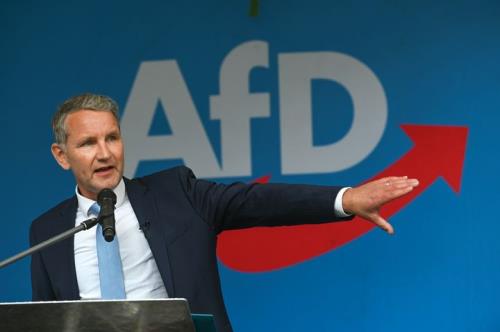
The far-right is gaining ground in Germany on strong resentment of Scholz's policies, with businessmen financially supporting the AfD's rise to power.
More than 30,000 people took to the streets of German cities last week, protesting against the far-right and their hardline positions on mass deportations of migrants.
The protests were sparked by the revelation that members of the far-right Alternative für Deutschland (AfD) party attended a meeting with neo-Nazis and other extremists to discuss the mass deportation of migrants, asylum seekers and German citizens of foreign origin who failed to integrate.
As the Guardian reports, the meeting took place in a hotel outside the former East German city of Potsdam on November 25, but was revealed on January 10 by the independent German news agency Correctiv.
According to reports by Die Zeit and Der Spiegel, the November secret meeting was the seventh, raising huge questions about what is happening in Germany as coup attempts in the country increase.
At the heart of the meeting was the speech of 29-year-old Martin Schellner, the Austrian leader of the ethno-nationalist movement "patriotic Greenpeace", who developed the possibilities of mass deportation of immigrants.
The "star" of the European extreme right
Schellner, who is seen as the new face of the far right in Europe, was among the most prominent speakers and, according to Correctiv, the meeting was attended by German businessmen who made generous donations to promote the policy of mass deportation, should the AfD rise in charge.
The event was organized by retired dentist Gernot Mörig, who once led the far-right Loyal Youth Union of the Fatherland, and businessman and investor Hans-Christian Limmer.
Also present were Mario Müller – a member of the Identitarian movement known for his international connections with far-right activists and an AfD parliamentary adviser as well as other top AfD members such as Roland Hartwig, adviser to the party's co-leader and parliamentary representative Alice Weidel.
Tim Krause, the party's regional chairman in Potsdam; and Ulrich Siegmund, parliamentary chairman in the state of Saxony-Anhalt.
However, the fact that two members of the ultra-conservative alliance WerteUnion, linked to the CDU/CSU Christian Democratic Party, took part in the meeting, with the Minister of the Interior, Nancy Feser, calling on the CDU to distance itself from the extreme right.
"A creeping normalization of inhumane and undemocratic far-right policies must not be allowed to continue," he said.
Attempt to constitutionally ban the AfD
The far-right meeting drew the ire of Chancellor Olaf Solz, who said it should be examined by the constitutional court, writing in X "we will not allow anyone to distinguish 'we' in our country based on whether someone has a history immigration or not".
Christian Dürr, head of the Democratic Party (FDP) parliamentary group, said the AfD's positions are reminiscent of the Nazi era as the party shows it "rejects democracy".
The anti-far-right protests were organized by a newly formed alliance called "Hand in Hand" who are promoting the constitutional ban of the AfD.
Although a large portion of Germans are in favor of banning the AfD it is difficult to vote as the other parties fear the impact of a possible failure.
Both Solz and his deputy, Robert Habeck, have warned of a backlash from AfD supporters if parliament fails to pass such a proposal.
Risk of rise of the extreme right in the government
The far-right AfD, founded in 2013 as an anti-establishment and anti-European Union voice by academics and economists, quickly morphed into a far-right anti-immigrant party.
It started to gain strength in 2015, when Angela Merkel opened Germany's doors to one million immigrants and refugees, and in 2017 it managed to enter the German Parliament (Bundestag) for the first time, as a strong opposition.
Its popularity has, however, increased significantly since the Russian invasion of Ukraine, due to German dissatisfaction with high energy bills, inflation and the accuracy and financial costs of defending Ukraine.
Solz policies strengthen the extreme right
Germans are deeply unhappy with the coalition government of Olaf Scholz, with the Socialists (SPD) having lost much of its electoral strength and the far right climbing to 20%, reaching as high as 36% in some parts of the former East Germany .
In August the party won its first mayoral seat, in the eastern state of Saxony-Anhalt, while in December the far-right candidate won the mayoral election in Saxony.
In its analysis, the Süddeutsche Zeitung expresses doubts about the political survival of Social Democrat Chancellor Olaf Scholz, characterizing "almost toxic the mixture created by the territorial mentality and the perception that 'we govern well, but the world doesn't understand it.'
"Perhaps Olaf Scholz's term in the chancellorship is no longer saved, this is something that the social democratic party will have to face soon" reports the German newspaper, meaning either a change of policy or politician.
Source: huffingtonpost.gr