A President who cannot form a sustainable government cannot carry the historical burden of the Cyprus solution
By Andreas Dimitriou *
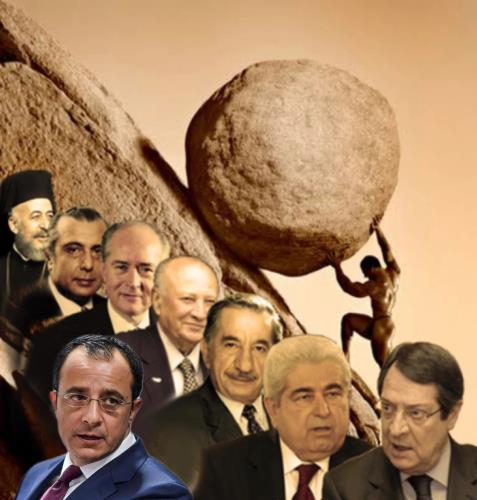
This article has been evolving for years, addressed to the newly elected President of the Republic, to point out that the office involves tragedy, personally and politically. The article shows the great institutional and historical constraints that the President must respect in order to avoid it. The article about the current President was delayed to be written because Nikos Christodoulidis is different from the previous ones. All previous Presidents were political leaders, with the exception of George Vassiliou, who was elected with the support of a major party, and all of them governed with a major party. Those that do not apply today. That is why I gave the President time to show if he can avoid the tragedy of the past. I show below that tragedy is coming – perhaps much worse than before. The work of all Presidents is like the work of Sisyphus, who never succeeds in raising the rock to the top of the mountain. As soon as he gets close to her, his rock slips away to start again. The end of each President's presidency always found him at the bottom of the hill. Remind:
Makarios came as Head of State. Within three years of the beginning of his first term, he experienced, as a protagonist, the collapse of the constitutional order, was ostracized by his competitors, deposed by the Holy Synod, collapsed by the junta coup against him, and experienced defeat and occupation of one third of Cyprus from Turkey. The tragedy of this course was beyond his strength. Thus, his heart stopped beating three years after the invasion, after he had the time to experience the agony of the Patriarch who during his days lost a third of Cyprus.
Spyros Kyprianou came as a representative of the younger generation of the struggle with the promise of liberating the occupied, expanding democracy and modernizing the state. He left after two or so terms with a complete failure in the Cyprus issue and with the reputation of the President who divided the state. Today it is cited by everyone as an example to avoid. What is the presidency for?
George Vassiliou came with many promises about the Cyprus issue and the management of the state and the economy. He is considered by many to be the best President of the Republic because he created great projects, such as the activation of the integration into the European Union and the creation of the University of Cyprus, which paved the way for the flourishing of university education that followed. However, the biggest project, the solution of the Cyprus issue, was not possible during his days. Thus, most promises remained unfulfilled, because the Cypriot people refused him re-election. It is obviously tragic for him, since the promises were left unfulfilled and his showdown with History failed.
Glaukos Cleridis came as the experienced negotiator, the sober leader with the trust of his old competitors, but also the trust of the other powers for his wisdom. He spent his first term trying to tame his own space, stabilize democracy and create the international treaties that would bring about the solution. These circumstances gave him a second term, which brought the Cypriot problem to a solution. Ultimately, however, he was rejected by his own space, because he succumbed to the history of that space instead of reforming it. Thus, the people refused him even the 16 months he was asking for to solve the Cyprus problem. Tragic for him and the place.
Tassos Papadopoulos came, with the support of the Left, to unify a divided society and make the state more fair, meritocratic and efficient. It also came with the promise of the best solution. Because of his stance in the referendum, the halo of the new Ethnarch was covered for a while. Ultimately it was associated with the revival of old divisions and the eclipse of hope. Thus, the Cypriot people denied him a second term, excluding him even from the second round of elections. It is tragic to lose the halo of the Nationalist within a few years.
Dimitris Christofias came with many promises and expectations. The international financial crisis and the explosion in Marie, which highlighted our inability to manage the complexity of the time, also put him on the path of tragedy. He failed to resolve the great political opposition of ruling left-wing in a right-wing environment. Thus, ineptitudes in the handling of the economy and in the management of the crisis in Marie put him in the sphere of the fatal tragedy of our Presidents. The end of his term and the bitterness that his every statement exuded are reminiscent of the tragedy.
"The crisis needs a leader": Nikos Anastasiadis came to tame the crisis. In just three weeks after his election, he began the Sisyphus march. His broken promises to cut deposits, his inability to convince the political system of the best option, and the banking collapse showed early on that his leadership was inadequate. Then the collapse of the Cyprus talks showed that he was no history maker. In fact, his promotion of the two-state solution reached the limits of treason. The connection in public opinion of the "golden" passports with his personal interests, the entanglement that touched all the institutions, and the characterization of his administration as a "mafia state", gave him the title of the President who cultivated corruption to unprecedented levels. His negative reputation is the worst tragedy a President can experience.
This is how we arrived at the election of the current President . An assistant of the time, who discredits political figures and parties with great speed, he was elected as incorruptible and incorruptible to overcome the sins of parties and previous Presidents. Thus we have the first President who does not lead a party and does not have the support of one of the two major parties. His election is obviously a great success. But tragedy strikes. The recent reshuffle was not done to bolster a successful run. His government collapsed under the weight of his own institutional, political and administrative inexperience.
The mistakes made in just ten months are many and big. The reorganization of a government of unsuitable, according to the President himself, ministers, deputy ministers, and other officials creates the feeling that the President does not understand the demands of the office. He governs by criteria his public image, which he cultivates through empty statements or actions. The article is being written at the time of the announcement of the new government. Unfortunately, the new government also reflects the same intention that led to the collapse of the previous one: the protection of the personal image of the President by selecting persons without a public role, institutional presence and without experience in managing large organizations. The next collapse is not far away.
Many actions of the President trivialize and demoralize office and politics. The examples are many. Tricks to circumvent the Constitution, as was done with the deputy government representative, show that the President does not respect the laws. Actions that bring him financial benefit, such as receiving a pension from previous service while he is acting President, show that he is subordinating the presidency to petty personal interests. The ease with which he lies to citizens and associates, as in the case of the recent reshuffle, show Machiavellianism far worse than the Presidents who preceded him.
Not much is expected for the Cyprus issue, not only because of the other side. A President who cannot form a sustainable government cannot bear the historical burden of the Cyprus solution. The dynamics that make him the last President before the split may already be set in motion. This ending will be tragic for him, because his position in History will be much worse than all previous Presidents. Much more, however, it will be tragic for the place, because it will close thousands of years of history with the stamp of betrayal.
All this will make us long for the days when the major parties ruled, which I hope will transcend the expectation of the temporary political benefit of an electoral contest to protect the country from the tragedy to come.
*former Minister of Education, academic, professor emeritus of the Universities of Cyprus and Nicosia