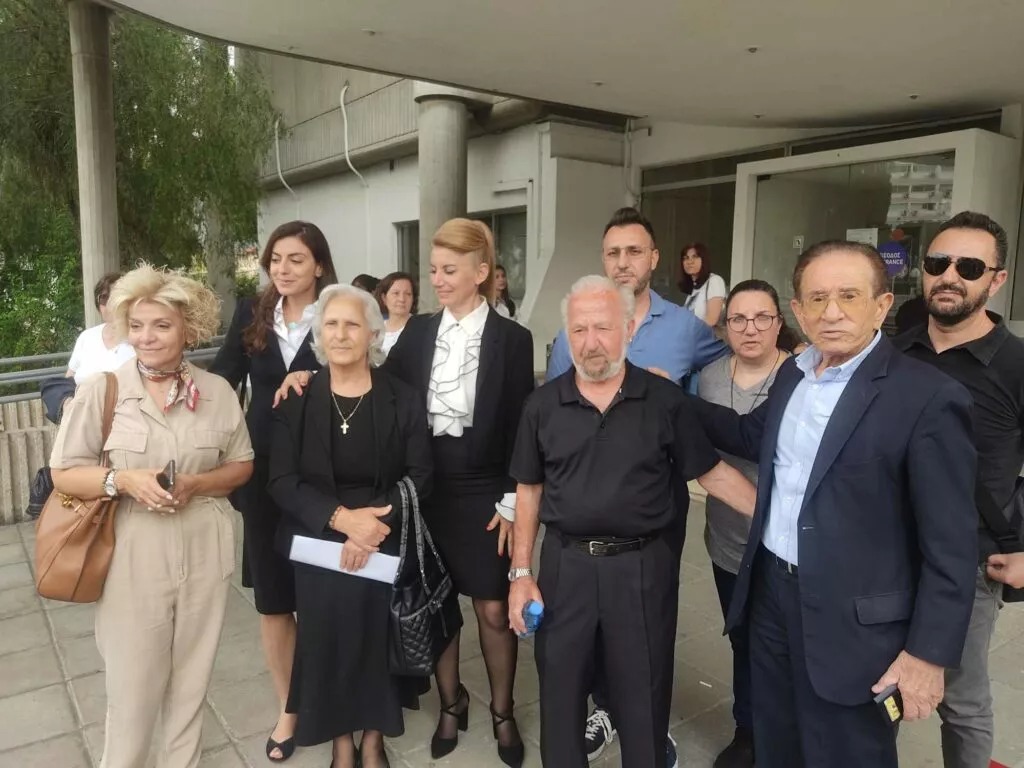
In a scathing critique of the Law Office’s handling of the Thanasis Nicolaou case, Judge Doria Varoshiotou of the Limassol District Court brought a significant shift to the 19-year-long struggle of the national guardsman’s family.
In her ruling, Judge Varoshiotou concluded, beyond any reasonable doubt, that Thanasis’ death resulted from a criminal act of strangulation.
Doria Varoshiotou dared to overturn the narrative that had persisted in courtrooms and police investigations for nearly two decades, delivering a rebuke to the Law Office, which contested the family’s claims and advocated that Nicolaou’s death was a suicide.
Thanasis’ body was found under a bridge in Alassa in 2005 and his death was deemed by the army and police as a suicide. But after his remains were exhumed in 2020 over suspicions of foul play, further autopsies showed he had been beaten and strangled.
The decision marks a significant victory for Nicolaou’s family, particularly his mother Andriana Nicolaou, who have tirelessly fought for justice since his death in September 2005.
The ruling now paves the way for a new direction in the case.
The next steps will be determined in the coming days as the Attorney General’s office thoroughly examines the findings of the third coroner’s inquest into Thanasis Nicolaou’s death.
The Attorney General may choose to appeal the ruling or order a new police investigation into the entire case history, guided by the coroner’s report.
This would be the sixth police investigation, primarily focusing on identifying credible evidence regarding Thanasis’ killers, as the report unequivocally points to a criminal act.
However, a challenge arises regarding the new investigation, as Andriana Nicolaou may refuse to cooperate with the police, questioning their impartiality and that of the Law Office, according to Phileleftheros.
Law Office under scritiny
In her ruling, judge Varoshiotou did not shy away from criticising the Law Office’s stance, noting that until the final stages of the proceedings, the prosecution maintained that the death resulted from a fall and suicide. “Even after the ECHR decision, the prosecution proposed Panikos Stavrianos as an expert witness, who, along with the police authorities, concluded that Thanasis had committed suicide,” she remarked.
She further highlighted that following the ECHR ruling, the Law Office neither accepted nor acknowledged the report by private criminal investigators Matsas and Alexopoulos, appointed by the Attorney General, which concluded that Thanasis’ death resulted from a criminal act.
The judge also mentioned the Law Office’s suggestion to keep the inquest findings ‘open’, without determining the cause of death.
She pointed out that this was the first time such a position had been expressed, as previously, the prosecution consistently argued that Thanasis’ death was due to a fall and suicide, adhering to the initial findings of Panikos Stavrianos.
Judge Varoshiotou went on to criticise the Law Office for questioning the scientific competence and validity of the findings presented by pathologist Dimitra Karagianni.
She emphasised that Karagianni was not chosen by Thanasis’ family but was assigned the case by the Athens Public Prosecutor’s Office, of which she is a member, based on a roster of experts.
Regarding the absence of a forensic pathologist’s testimony, the judge noted that none of the pathologists, except for Philippos Koutsafis, prepared a report following the exhumation of Thanasis’ remains, despite having the right to do so.
Stavrianos seeks to appeal the ruling
The ruling has prompted the first response from Panikos Stavrianos, who has instructed his lawyer, Andrianna Klaedes, to challenge and seek the annulment of the decision.
According to Phileleftheros, Stavrianos intends to file an application with the Supreme Court for a writ of certiorari, requesting the coroner’s report be quashed.
Strangulation evidenced by neck bruises
In her conclusion, Judge Varoshiotou affirmed her acceptance of the scientific basis and correctness of the pathologists’ findings presented in the case. She supported Karagianni’s argument that the absence of the left horn of the hyoid bone indicated an injury sustained while Thanasis was alive, consistent with strangulation.
Additionally, the judge accepted the position that the irregular edge observed at the site of the hyoid bone fracture suggested the application of pressure and force.
Varoshiotou also agreed with Karagianni’s thoroughly substantiated view that the bruises on Thanasis’ neck confirmed strangulation.
She explained that in cases of strangulation, dark bluish marks are typically found on the neck due to the pressure exerted by the perpetrator’s fingers.
Read more:
strangulation. strangulation, criminal act, Law Office