Despite highs, economic uncertainty declines slightly

Despite highs, economic uncertainty declines slightly

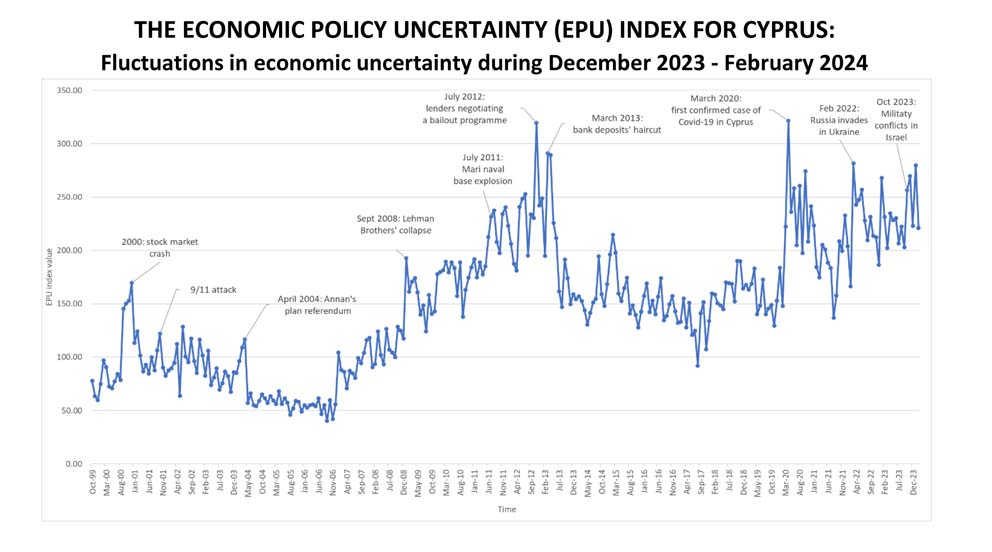
The level of economic uncertainty in Cyprus, as measured by the Economic Policy Uncertainty (EPU) index, fluctuated from December 2023 to February 2024. It increased in January 2024 to 279.76, attributed to geopolitical turmoil, including the crisis in the Middle East and the Red Sea, before dropping to 221.14 in February. This pattern of fluctuation was also observed in the European EPU index. The University of Cyprus noted that economic uncertainty in Cyprus has been historically high, with significant peaks in 2012 due to the banking crisis, in 2020 due to the Covid-19 pandemic, and in 2022 due to the Russia-Ukraine war.

Platform set up to evaluate business, ’ ESG compliance

Platform set up to evaluate business, ’ ESG compliance

The Cyprus Credit Bureau, in collaboration with the Cyprus Banks Association and ICAP CRIF, is introducing a tool for assessing compliance with ESG (Environmental, Social, Governance) criteria through the Interbank Business Evaluation Project using Synesgy, a global digital platform. This initiative aims to enhance transparency and sustainability in Cyprus by enabling companies of all sizes and sectors to assess their ESG compliance and obtain a certificate valid for one year. Companies will receive a personalized Action Plan with recommendations for improving their ESG performance based on the assessment results. The methodology for evaluating a company’s ESG data adheres to current international and European regulations and standards, and the Synesgy questionnaire is certified by the CRIF Rating Agency. The platform facilitates easy access for businesses to complete the questionnaire, which is crucial for accurate ESG assessment and is shared with the company’s banking partners. Yiannis Tomasides, General Manager of Artemis Credit Bureau, highlighted the project’s significance in evaluating and enhancing the ESG performance of Cypriot companies and banks, contributing to the development of an ESG ecosystem in Cyprus.

Calls for resignation over money laundering oversight

Calls for resignation over money laundering oversight

MPs in Cyprus have expressed concerns over the country’s compliance with money laundering regulations due to a lack of coordination and communication between the police, the money laundering unit (Mokas), and the customs office. Over €160 million in cash has entered Cyprus in the past four years, raising questions about tax evasion and money laundering investigations. A recent case involved the arrest of a 31-year-old Ukrainian woman facing 60 counts of money laundering, having brought €8 million in cash to the country. There is criticism over a “strange” meeting in 2023 where police allegedly instructed the customs office to route information through them before reaching Mokas, a directive not supported by law. The customs office provides Mokas with a USB detailing declared cash sums every three months, indicating a delay in communication. Concerns were raised about the lack of real-time information sharing, the effectiveness of the legal framework against money laundering, and the existence of a shadow economy. The committee chair criticized the absence of coordination among state services and described the situation as “criminal” due to the inaction of Mokas and the police.

Cabinet approves 1,000 electric car chargers

Cabinet approves 1,000 electric car chargers

The cabinet approved the creation of 1,000 charging stations for electric vehicles as part of the Cyprus Recovery and Resilience Plan. The transport ministry is tasked with the project’s implementation, aimed at promoting electric vehicle adoption and transitioning to a green economy. The project, with a budget of €2.5 million, seeks to reduce greenhouse gas emissions and promote sustainable technologies.

Cyprus signs multi-million deal with Microsoft to boost public sector efficiency

Cyprus signs multi-million deal with Microsoft to boost public sector efficiency

Cyprus has signed an €8 million deal with Microsoft to provide 10,000 public sector workers with Microsoft 365 licenses and to upgrade the country’s digital infrastructure. This five-year Enterprise Agreement includes email, secure collaboration tools, cloud computing services, project management, reporting software, and support services from Microsoft specialists for smooth implementation and user training. Deputy Minister of Research, Innovation and Digital Policy, Nicodemos Damianou, sees this as the start of broader cooperation with Microsoft, aiming to create a modern, digital state. Yanna Andronopoulou, Managing Director for Microsoft Greece, Cyprus, and Malta, views the agreement as a significant step towards Cyprus’s digital future. The agreement aims to improve public sector efficiency and service quality for Cypriot citizens, marking a milestone in Cyprus’s digital modernisation efforts.

Our View: What are schools if not human centred?

Our View: What are schools if not human centred?

Education Minister Athena Michaelidou prioritized the transition to a modern, human-centred, and inclusive school system that cultivates abilities, skills, and knowledge for the next school year.

Trade deficit narrows in January after plunge in imports

Trade deficit narrows in January after plunge in imports

– The January foreign trade deficit in Cyprus decreased to a third of the level from the previous year, primarily due to a significant reduction in imports, especially in the transfer of ships and other vessels.
– The trade deficit for the entire year of 2023 narrowed by €313 million.
– Total imports of goods in January were €848.1 million, a 51.1% decrease from €1,735.1 million in January 2023.
– Total exports in January were €281.5 million, a 10.7% decrease from €315.2 million in January 2023.
– The trade deficit in January 2024 was €566.5 million, down from €1,419.9 million in January 2023.
– Imports from other EU member states were €510.7 million, and from third countries were €337.4 million, compared to €529.1 million and €1,206.0 million, respectively, in January 2023.
– Exports to other EU member states were €103.5 million, and to third countries were €178.1 million, compared to €69.8 million and €245.4 million, respectively, in January 2023.
– January imports included the transfer of economic ownership of vessels worth €65.2 million, compared to €936.3 million in January 2023.
– January exports included the transfer of economic ownership of vessels and aircraft worth €69.5 million, compared to €107.5 million in January 2023.
– Excluding ships, the January foreign trade deficit slightly increased from €570.9 million in 2024 to €591.1 million in the same month of the previous year.
– Total imports of goods in December amounted to €928.4 million, a 9.6% increase from €847.3 million in December 2022.
– Total exports in December reached €389.9 million.
– Total imports for all of 2023 were €12,948.9 million, and exports were €4,686.3 million.
– The foreign trade deficit for all of 2023 was adjusted to €8,262.6 million, narrower than the €8,575 million based on provisional data for December.
Australia, ’s Great Barrier Reef suffers major coral bleaching

Australia, ’s Great Barrier Reef suffers major coral bleaching

Australia’s Great Barrier Reef is experiencing a major coral bleaching event, confirmed by the Great Barrier Reef Marine Park Authority (GBRMPA). This event is consistent with patterns of heat stress accumulated over the summer. The bleaching is extensive in shallow water areas, but in-water surveys are needed to confirm the severity and depth range of the bleaching. The bleaching is attributed to elevated sea surface temperatures driven by climate change and amplified by El Nino. This marks the fifth mass bleaching event in eight years, indicating significant pressure from climate change on the reef. Coral bleaching causes corals to expel the algae living in their tissues, turning them white, which can affect their growth and reproduction. The Great Barrier Reef contributes about A billion to the economy and supports 64,000 jobs.

Eurozone to phase out energy support measures

Eurozone to phase out energy support measures

Eurozone finance ministers decided to gradually phase out energy support measures in 2024 to reduce government deficits. This decision was emphasized during the Eurogroup meeting of finance ministers. The Cyprus government plans to end the reduced consumer tax on car fuel and the subsidy of electricity bills by the end of April 2024. A political agreement on reforming the EU’s economic governance framework was reached in February 2024, with optimism for its early adoption. Ministers provided a cautiously optimistic outlook for the euro area’s economy in 2025, citing a robust labour market and a downward inflation path. However, they acknowledged economic risks due to global uncertainty. The reformed framework aims at strengthening debt sustainability and promoting growth through structural reforms and investment. An overall slightly contractionary fiscal stance is expected in the euro area for 2025, focusing on priority areas like the green and digital transition and defence capabilities, with an emphasis on improving the efficiency, quality, and composition of public spending.

Cyprus already in line with eurozone fiscal policy plan

Cyprus already in line with eurozone fiscal policy plan

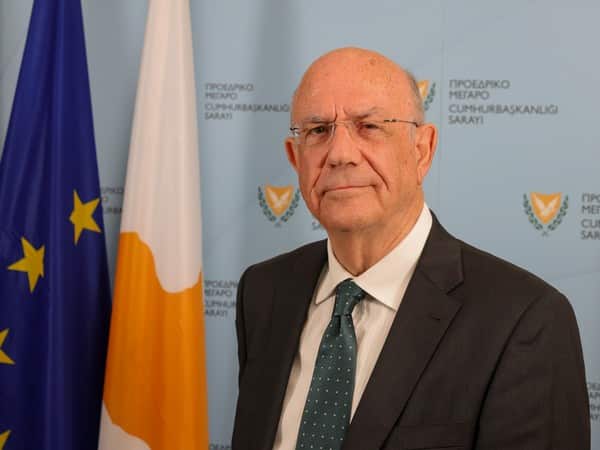
Finance Minister Makis Keravnos expressed satisfaction with the eurozone’s fiscal policy orientation for 2025, stating that Cyprus’ conservative fiscal approach aligns with it. He mentioned that the joint statement validates Cyprus’ cautious conservative fiscal policy and efforts towards transitioning to the green and digital economy. Keravnos also supported the proposal to unify capital markets in the EU, highlighting its benefits for investor security and development. Regarding the Recovery and Resilience Facility, he noted that Cyprus is making good progress and is addressing issues while preparing for future funding tranches.