Gold poised to hit $2,250 Q2 target, say economists

Gold poised to hit $2,250 Q2 target, say economists

Gold’s price decreased by 1.1% following a higher-than-expected US inflation report. Economists from TD Securities predict that the price of gold may decrease further to a range between ,025 and ,100. The February Consumer Price Index (CPI) showed core inflation at 0.4% month-over-month, reaching 3.8% year-over-year, and headline inflation also increased by 0.4% month-over-month to 3.2% year-over-year. This inflation data suggests the Federal Reserve may not reduce interest rates soon. Despite this, TD Securities still sees potential for gold to reach a ,250 target in the second quarter if economic data continues to weaken. ANZ Bank economists also noted that the unexpected US inflation figures have negatively impacted gold prices, affecting market expectations for a rate cut in June. Commerzbank analysts attribute the recent rise in gold prices to speculative financial investors, with net long positions in gold futures increasing significantly. However, they caution that higher-than-expected US inflation could lead to a decrease in gold prices, especially if speculative investors decide to take profits.


Real estate sector depends on outside factors

Real estate sector depends on outside factors

The Cyprus economy has shown strong resilience, recording one of the highest growth rates in the European Union, according to Dr. Giorgos Mountis, CEO of Delfi Partners. The Cypriot economy grew by 2.4% in 2023 and is estimated to grow by 2.8% in 2024 and 3% in 2025. Inflation decreased from 8.1% in 2022 to 3.9%, with further reductions expected to 2.4% in 2024 and 2.1% in 2025. Efforts to contain inflation involved decisions that temporarily affected citizens’ incomes, with interest rate increases placing significant pressure on household incomes. However, optimism exists that the European Central Bank’s decisions will start to change in 2024, potentially leading to a decrease in domestic interest rates. Unemployment is at very low levels, approaching full employment, though many sectors face personnel shortages. The government’s strategies to employ and attract foreign labor could lead to an increase in the country’s population and economic development. The real estate sector remained resilient in 2023, with sales contracts increasing by 16% compared to 2022, reaching the highest level since 2008, driven by increased demand from non-European buyers. Apartment prices in 2023 exceeded those of 2010 for the first time, according to the Central Bank of Cyprus, leading to an increase in properties purchased for rental investment.

Bitcoin hits record above $71,000 as demand frenzy intensifies

Bitcoin hits record above $71,000 as demand frenzy intensifies

– Bitcoin reached a record high above ,000 on Monday.
– Britain’s financial watchdog will now allow recognized investment exchanges to launch crypto-backed exchange-traded notes.
– Bitcoin’s price rose by as much as 4.8 percent to ,677 in European trading, with gains for the year at 70 percent.
– The surge in Bitcoin’s value is attributed to an influx of cash into new spot bitcoin exchange-traded funds and expectations of a Federal Reserve interest rate cut.
– Capital flows into the 10 largest U.S. spot bitcoin exchange-traded funds reached almost billion in the week to March 8.
– The supply of Bitcoin, limited to 21 million tokens, is expected to get tighter in April due to the halving event, which occurs every four years and reduces the rate of new supply and the reward for miners.
– The UK regulator stated that crypto exchange-traded notes (ETNs) would be available only for professional investors.
– Asset managers hold the largest bullish position in bitcoin futures on record, with a net long position worth .5 billion.
– Ether’s price rose 2.1 percent to around ,000, driven by speculation of U.S. approval for spot ether ETFs, with a 75 percent increase in price this year.

Europe, ’s stocks fall from record highs, inflation data in focus

Europe, ’s stocks fall from record highs, inflation data in focus

European stock indexes fell from recent record highs on Monday, with Wall Street also expected to face losses. This shift in the market is attributed to an uncertain economic outlook and anticipation for U.S. inflation data set to be released later in the week. U.S. stocks began to decline from record highs on Friday, a move analysts believe was due to profit-taking after mixed U.S. payrolls data, yet expectations for a Federal Reserve rate cut in June remained. Traders are now focused on the upcoming U.S. inflation data, which could influence expectations for when major central banks will start reducing rates. As of 1236 GMT, the MSCI World Equity index was down by 0.3 percent after reaching a new all-time high on Friday. Similarly, the pan-European STOXX 600, which also reached a new all-time high on Friday, was down by 0.5 percent. London’s FTSE 100 and Germany’s DAX experienced declines of 0.5 percent and 0.7 percent, respectively. Amelie Derambure, a senior multi-asset portfolio manager at Amundi, suggested that Monday’s downturn might be due to uncertainty about the economic outlook and high stock valuations. Recent comments from Fed Chair Jerome Powell and European Central Bank policymakers have raised expectations for interest rate cuts starting in the summer, which contributed to pushing stock indexes to new highs.

Gold rally could extend beyond recent highs

Gold rally could extend beyond recent highs

Gold has increased by nearly 19% since a low in October and about 7% in the past month. UBS strategists suggest there might be a short-term pullback in gold prices, but the rally could continue over the year. Factors supporting gold include potential Federal Reserve rate cuts, central banks and investors buying gold, and increased geopolitical risks. Gold prices have surpassed ,180, reaching near ,200 highs in Asian trading. The Federal Reserve’s potential rate cuts this year and ongoing geopolitical tensions are supporting gold’s value. Fed Chair Jerome Powell indicated the U.S. economy is healthy, and rate cuts could begin once there is confidence in inflation’s downward trajectory. Futures markets anticipate a 70% chance of the Fed cutting rates by mid-June, with a total of one percentage point reduction by year-end. U.S. Nonfarm Payrolls (NFP) data for February showed 275,000 jobs added, exceeding expectations and potentially influencing Fed rate decisions. China’s inflation data for February indicates a return to normal consumption levels, positively affecting gold prices as China is a major consumer of gold. The Chinese Consumer Price Index (CPI) increased by 0.7% year-over-year in February, and the Producer Price Index (PPI) declined by 2.7% year-over-year in the same month. Upcoming U.S. CPI and Retail Sales data for February are awaited for further market direction, with CPI expected to increase by 0.4% month-over-month and Retail Sales projected to rise by 0.7% month-over-month.

Michael Saylor wants to raise $600M to buy more Bitcoin (BTC) as NuggetRush reaches new highs in funds raised

Michael Saylor wants to raise $600M to buy more Bitcoin (BTC) as NuggetRush reaches new highs in funds raised

– MicroStrategy plans to sell 0 million in convertible senior notes to fund additional Bitcoin purchases and already owns 193,000 Bitcoin. Michael Saylor, the company’s executive chairman, believes Bitcoin is the world’s most popular investment asset.
– NuggetRush (NUGX) is a new GameFi project on the Ethereum blockchain, integrating crypto trading, artisanal mining, and play-to-earn mechanics. It aims to impact the physical world positively and has a defined roadmap for its 500 million tokens distribution.

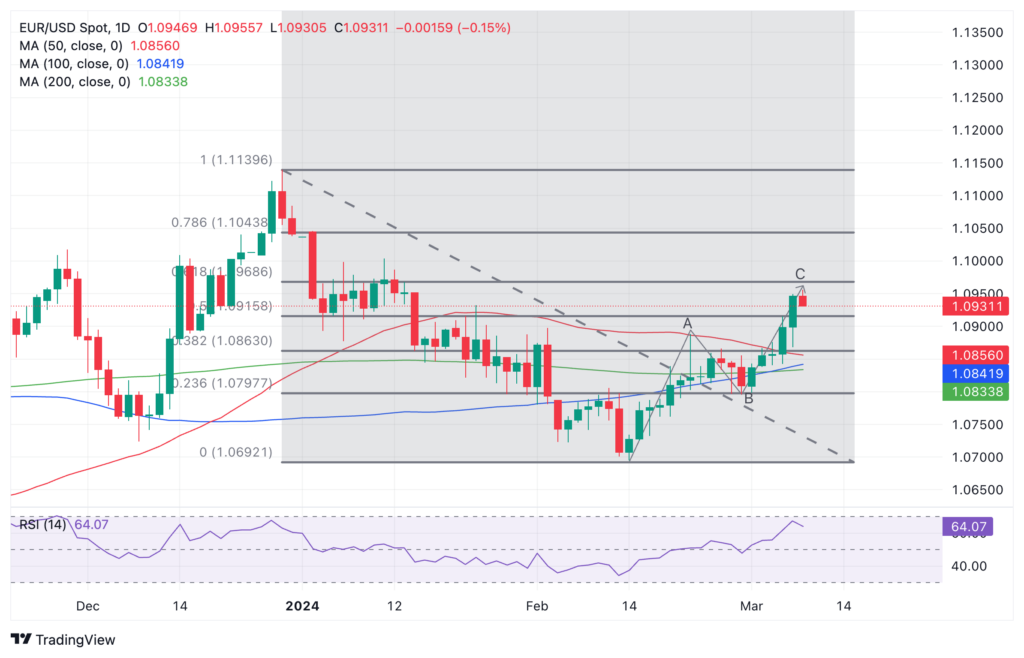
EURUSD recovers after release of US NFP

EURUSD recovers after release of US NFP

– The EUR/USD pair increased after US Nonfarm payrolls data showed a decrease in Average Hourly Earnings and an increase in the Unemployment Rate.
– The US economy added 275,000 jobs in February, more than the 200,000 expected.
– Average Hourly Earnings rose by 4.3% YoY and 0.1% MoM, both below the predicted 4.4% and 0.3%.
– The Unemployment Rate increased to 3.9%, higher than the expected 3.7%.
– This data could lead the Federal Reserve to cut interest rates earlier than anticipated.
– Francois Villeroy de Galua, Governor of the Bank of France and ECB Governing Council member, stated a rate cut in spring is “very likely.”
– Joachim Nagel, Bundesbank President, mentioned the increasing probability of an interest-rate cut before the summer break.
– ECB President Christine Lagarde indicated June as the next key date for reviewing policy on interest rates.
– The EUR/USD is in a short-term uptrend due to the anticipation that the US Fed might lower interest rates sooner than the ECB.
– Technical analysis suggests a tentative short-term uptrend for EUR/USD, with recent signs indicating a possible correction.

Sterling is on the move

Sterling is on the move

The British Pound is experiencing its strongest performance against the US dollar and other major currencies in over seven months. This change is attributed to investors and traders adjusting to a new perspective on the UK’s economy, which has shown resilience despite challenges such as Brexit and geopolitical tensions. Initially, there was an expectation of four interest rate cuts by the Bank of England to address the cost of living crisis and prevent a deep recession. However, current expectations have shifted to potentially only two interest rate cuts this year, based on economic data indicating better-than-expected GDP growth and consumer spending. Additionally, comments from the Fed Chairman have led traders to believe that the Federal Reserve might implement more interest rate cuts than the Bank of England, further influencing the strength of the British Pound.

ECB takes small step towards rate cut as inflation falls

ECB takes small step towards rate cut as inflation falls

The European Central Bank (ECB) maintained borrowing costs at record highs but indicated a move towards reducing them, noting that inflation is decreasing faster than expected. The ECB’s main interest rate remains at 4.0 percent, reflecting a continued decrease in inflation over the past 1.5 years and revised, lower economic projections. Despite this, domestic price pressures, including wages, are still high. The ECB plans to base future decisions on the path of underlying inflation. It is unlikely to lower borrowing costs before its June 6 meeting, with crucial wage data expected in May. The ECB has revised its inflation forecast for this year from 2.7 percent to 2.3 percent, suggesting it might achieve its 2 percent inflation target earlier than the previously expected 2025. However, core inflation, excluding food and fuel, remains at 3.1 percent. Economic growth in the eurozone is projected to be 0.6 percent, down from a previous estimate of 0.8 percent.

Emergency cash at a cost: The reality of payday loans

Emergency cash at a cost: The reality of payday loans

A payday loan is a short-term financial solution offering immediate cash, typically up to £1,000, expected to be repaid by the borrower’s next paycheck. These loans have an average annual percentage rate (APR) often exceeding 400%, making them one of the most expensive forms of credit. The high interest rates and penalties for late payment can trap borrowers in a cycle of debt. Alternatives to payday loans include building an emergency savings account, borrowing from family or friends, seeking an advance from an employer, or exploring financial assistance from local charities, credit unions, and banks which may offer lower interest rates.