The Fed, the whole Fed and nothing but the Fed

The Fed, the whole Fed and nothing but the Fed

– The USD Index (DXY) reached three-week highs past the 104.00 mark on Tuesday, despite a decline in US yields.
– The Federal Reserve’s interest rate decision and the FOMC Economic Projections, along with Chair Jerome Powell’s press conference, are scheduled for Wednesday.
– The EURUSD pair fell to multi-week lows near the 1.0830 region, testing the critical 200-day SMA.
– ECB’s Christiane Lagarde is set to speak on Wednesday, and the European Commission will release its flash Consumer Confidence gauge.
– The GBPUSD pair moved beyond 1.2700 towards the end of the NA session on Tuesday after reversing an earlier pullback to the 1.2670 zone.
– The UK will report the Inflation Rate on March 20.
– The USDJPY pair approached the 151.00 mark, near 2024 highs, due to increased selling pressure on the yen following the BoJ rate hike.
– The AUDUSD pair approached the 0.6500 support level for the fourth consecutive session, influenced by a stronger USD and the RBA’s dovish stance. The RBA’s Consumer Inflation Expectations are due on March 20.
– WTI oil prices surpassed .00 per barrel, reaching four-month highs, driven by geopolitical factors and anticipated stronger demand.
– Gold prices saw modest losses around the ,150 per troy ounce zone, affected by the stronger Dollar and lower US yields.
– Silver prices dropped for the second consecutive session after reaching highs near .50 per ounce on Friday.

WTI steady at $80.60, below YTD peak

WTI steady at $80.60, below YTD peak

– West Texas Intermediate (WTI) crude oil prices are fluctuating just above the mid-.00s in Asian trading on a Friday.
– Prices are close to the highest level since November 6, as observed the previous day.
– The US Producer Price Index (PPI) was higher than expected, suggesting the Federal Reserve might maintain high interest rates to combat inflation, potentially reducing economic activity and fuel demand.
– Concerns about a slowdown in China also negatively impact crude oil prices.
– Factors supporting oil prices include a significant drop in US inventories, drone strikes on Russian refineries, and increased energy demand forecasts.
– The US Energy Information Administration reported a decrease of about 1.5 million barrels in US crude stockpiles for the week ending March 8.
– A drone attack attributed to Ukraine caused a fire at Rosneft’s largest refinery in Russia.
– The International Energy Agency has raised its 2024 oil demand growth forecast for the fourth time since November due to supply disruptions from Houthi attacks in the Red Sea.
– OPEC+ members have agreed to extend production cuts of 2.2 million barrels per day through the second quarter, supporting higher crude oil prices.
– Crude oil is on track for strong weekly gains, with market focus shifting to the upcoming FOMC monetary policy meeting.

Euro awaits US data, ECB speakers

Euro awaits US data, ECB speakers

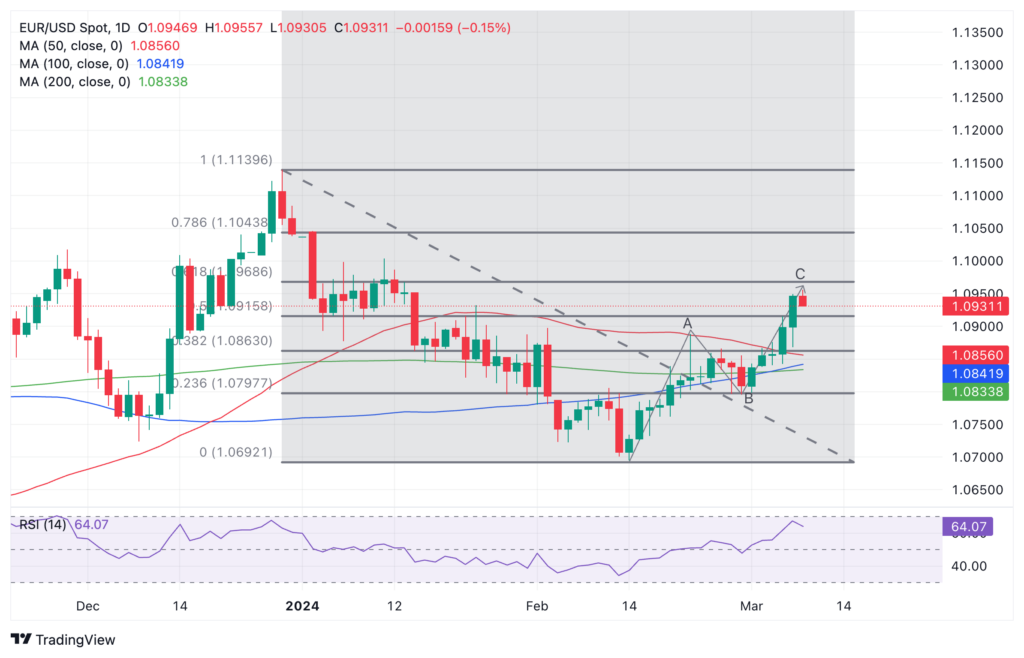
The EURUSD exchange rate was trading in the mid 1.0900s after reaching a peak at 1.0981 the previous week. Upcoming data releases and events are expected to introduce some volatility to the Euro-dollar pair. In the US, upcoming factory gate inflation and Retail Sales data could influence expectations regarding the Federal Reserve’s timeline for interest rate cuts, which is a significant factor for the US Dollar. Economists anticipate a decrease in Core PPI to 1.9% year-over-year in February from 2.0% in January, with a month-on-month forecast showing a 0.2% increase compared to the 0.5% increase the previous month. The headline Producer Price Index (PPI) is expected to show a 1.1% year-over-year gain, up from 0.9% in January, and a 0.3% month-on-month gain, consistent with the previous month. This data is a crucial indicator for CPI inflation, as increases in wholesale costs are typically passed on to consumers. Market participants are betting on a 67.2% probability of the Fed cutting interest rates in June, according to the CME FedWatch Tool. US Treasury Secretary Janet Yellen stated that it seems unlikely for interest rates to return to pre-COVID-19 levels and deemed the interest rate projections in President Biden’s budget plan as “reasonable.” In Europe, several ECB officials are set to speak, potentially providing insights into whether interest rates will be cut in April or June. If inflation remains high, interest rates are likely to stay elevated, supporting the Euro. ECB Governing Council member Francois Villeroy de Galhau indicated a preference for an April rate cut, while Bank of Austria Governor Robert Holzmann and ECB President Christine Lagarde suggested a June timeline for revisiting rate policies. The timing of ECB rate cuts could impact the Euro and EURUSD exchange rate. After recent US inflation data, a calmer period is expected in the EURUSD pair ahead of the next week’s Federal Reserve meeting.

Gold poised to hit $2,250 Q2 target, say economists

Gold poised to hit $2,250 Q2 target, say economists

Gold’s price decreased by 1.1% following a higher-than-expected US inflation report. Economists from TD Securities predict that the price of gold may decrease further to a range between ,025 and ,100. The February Consumer Price Index (CPI) showed core inflation at 0.4% month-over-month, reaching 3.8% year-over-year, and headline inflation also increased by 0.4% month-over-month to 3.2% year-over-year. This inflation data suggests the Federal Reserve may not reduce interest rates soon. Despite this, TD Securities still sees potential for gold to reach a ,250 target in the second quarter if economic data continues to weaken. ANZ Bank economists also noted that the unexpected US inflation figures have negatively impacted gold prices, affecting market expectations for a rate cut in June. Commerzbank analysts attribute the recent rise in gold prices to speculative financial investors, with net long positions in gold futures increasing significantly. However, they caution that higher-than-expected US inflation could lead to a decrease in gold prices, especially if speculative investors decide to take profits.

EURGBP gains ground following UK jobless, German CPI

EURGBP gains ground following UK jobless, German CPI

– Euro-Sterling was trading below the mid-0.8500s during early European trading on Tuesday.
– The EURGBP cross was trading around 0.8540, gaining 0.16% on the day.
– The UK ILO Unemployment Rate increased to 3.9% in the three months to February from 3.8%.
– The number of people claiming jobless benefits in the UK rose by 16,800 in February.
– The UK Employment Change was -21,000 in January.
– The German Consumer Price Index (CPI) for February was 0.4% MoM and 2.5% YoY.
– The German Harmonized Index of Consumer Prices (HICP) for February was 0.6% MoM and 2.7% YoY.
– Upcoming data releases include the UK monthly GDP, Industrial Production, Manufacturing Production, and Trade Balance for January.

WTI moves in tight range, hovers around $77.80

WTI moves in tight range, hovers around $77.80

– The benchmark West Texas Intermediate (WTI) crude oil price was around .80 per barrel in Asian trading on Tuesday.
– Oil markets are awaiting the release of the Consumer Price Index (CPI) data from the United States, with expectations for a modest uptick in February’s US inflation figures, but the annual index is forecasted to hold steady.
– A strong CPI report could decrease the likelihood of an immediate rate cut by the Federal Reserve, potentially bolstering the US Dollar and challenging crude oil prices.
– The probability of a rate cut in June has slightly decreased to 68.9%, according to the CME FedWatch Tool.
– Market participants are looking forward to monthly market reports from OPEC, the International Energy Agency (IEA), and the Energy Information Administration (EIA) to assess the global demand outlook.
– ANZ analysts expect demand projections from the monthly reports of the three major oil agencies to remain largely unchanged, but any unexpected upward revisions could alleviate demand concerns.
– The US has led global oil production for the sixth consecutive year, with a record-breaking average production of 12.9 million barrels per day (bpd).
– US crude oil production reached a new monthly record high of over 13.3 million bpd in December.

Gold rally could extend beyond recent highs

Gold rally could extend beyond recent highs

Gold has increased by nearly 19% since a low in October and about 7% in the past month. UBS strategists suggest there might be a short-term pullback in gold prices, but the rally could continue over the year. Factors supporting gold include potential Federal Reserve rate cuts, central banks and investors buying gold, and increased geopolitical risks. Gold prices have surpassed ,180, reaching near ,200 highs in Asian trading. The Federal Reserve’s potential rate cuts this year and ongoing geopolitical tensions are supporting gold’s value. Fed Chair Jerome Powell indicated the U.S. economy is healthy, and rate cuts could begin once there is confidence in inflation’s downward trajectory. Futures markets anticipate a 70% chance of the Fed cutting rates by mid-June, with a total of one percentage point reduction by year-end. U.S. Nonfarm Payrolls (NFP) data for February showed 275,000 jobs added, exceeding expectations and potentially influencing Fed rate decisions. China’s inflation data for February indicates a return to normal consumption levels, positively affecting gold prices as China is a major consumer of gold. The Chinese Consumer Price Index (CPI) increased by 0.7% year-over-year in February, and the Producer Price Index (PPI) declined by 2.7% year-over-year in the same month. Upcoming U.S. CPI and Retail Sales data for February are awaited for further market direction, with CPI expected to increase by 0.4% month-over-month and Retail Sales projected to rise by 0.7% month-over-month.

Gold extends rally above $2,160 ahead of US NFP

Gold extends rally above $2,160 ahead of US NFP

The price of gold reached a new all-time high above ,160, influenced by a weaker US Dollar, a decline in US Treasury bond yields, and expectations for a rate cut by the Federal Reserve in June. Dovish commentary from central bank policymakers, including Fed Chair Jerome Powell and European Central Bank chief Christine Lagarde, also supported gold prices. Powell indicated the Fed is close to being confident enough to cut rates, while Lagarde suggested the ECB might ease policy in June. Additionally, geopolitical tensions and safe haven buying, particularly following a Houthi attack in the Red Sea, contributed to the demand for gold. Despite investors pulling metal out of Gold-backed ETFs, central banks remain strong buyers of gold.

EURUSD recovers after release of US NFP

EURUSD recovers after release of US NFP

– The EUR/USD pair increased after US Nonfarm payrolls data showed a decrease in Average Hourly Earnings and an increase in the Unemployment Rate.
– The US economy added 275,000 jobs in February, more than the 200,000 expected.
– Average Hourly Earnings rose by 4.3% YoY and 0.1% MoM, both below the predicted 4.4% and 0.3%.
– The Unemployment Rate increased to 3.9%, higher than the expected 3.7%.
– This data could lead the Federal Reserve to cut interest rates earlier than anticipated.
– Francois Villeroy de Galua, Governor of the Bank of France and ECB Governing Council member, stated a rate cut in spring is “very likely.”
– Joachim Nagel, Bundesbank President, mentioned the increasing probability of an interest-rate cut before the summer break.
– ECB President Christine Lagarde indicated June as the next key date for reviewing policy on interest rates.
– The EUR/USD is in a short-term uptrend due to the anticipation that the US Fed might lower interest rates sooner than the ECB.
– Technical analysis suggests a tentative short-term uptrend for EUR/USD, with recent signs indicating a possible correction.

UK in recession, but that, ’s unlikely to sway BoE

UK in recession, but that, ’s unlikely to sway BoE

The UK fell into recession in the second half of last year with a steeper contraction in GDP than expected. The economy has been stagnant for the past couple of years and is expected to bounce back this year. Weaker household spending may suggest weaker demand than anticipated. Inflation is expected to fall, which could lead to a debate around rate cuts. Oil prices remain volatile due to uncertainty in the Middle East, the economy, and interest rates. Gold has dropped below ,000, indicating that rates may not fall as soon or as fast as hoped. Bitcoin has reached a new two-year high above ,500.