Brussels: Andria Georgiou
In 2022, 374,800 cases of breast cancer in women were recorded in the European Union, while based on calculations in the next 16 years, until 2040, these cases will reach 412 thousand, i.e. they will increase by 10%. In 2022, 319,200 people, men and women, were diagnosed with lung cancer in the EU, with experts predicting that in 2040 these cases will exceed 382,000, an increase of 20%. It is predicted that the increase in cases of prostate cancer for men (24%), bowel cancer (23%) and stomach cancer (23%) will also be significant. Along with the new cases, it is estimated that the deaths will also increase. For example, in 2022, 95,800 women will die of breast cancer and 76,700 men will die of prostate cancer. These numbers are expected to reach 116,500 and 109,200 respectively in 2040. This means that if the predictions of the experts are confirmed in the next 16 years, deaths from prostate cancer will increase by 42%. All this while four out of ten new cancer cases in the EU could be prevented. At least this is what the commissioner for Health and Food Safety, Stella Kyriakidou, said last Wednesday, January 31, during a conference on the European Union's plan to strengthen the fight against cancer. On the occasion of today's day dedicated to the fight against cancer, Mrs. Kyriakidou took stock of the efforts and actions of the EU to reduce mortality due to cancer and to improve the lives of those affected by the disease. The conference discussed, among other things, how collaboration under the EU Cancer Plan has made a difference to cancer care in the EU, how better outcomes can be achieved in childhood cancer through strengthening research, the importance of quality of cancer screening and measures that national systems can take to convince more citizens of the importance of screening and access to psychosocial oncology care, were some of the topics that emerged through the discussion.
EU actions
Where someone lives should not affect their access to health services, especially when we talk about programs and services that help prevent cancers, Ms. Kyriakidou said, among other things. "Thanks to the first EU Cancer Inequalities Register, we are today publishing a report with updated cancer data, which clearly shows that not everyone in the EU has the same chance of beating cancer," said the commissioner. "With a funding boost of 4 billion euros, we have launched a record number of projects, actions and initiatives that address every stage of the disease," he stressed. He added that all actions are now based on the latest research and innovation, with the EU after nearly 20 years having new up-to-date and evidence-based screening guidelines covering types of cancer which together account for more than half of all of new cases diagnosed in the EU each year. A training program for cancer professionals now operates cross-border, he added, and young cancer patients support each other through a Cancer Experienced Youth Network. “We are making steady progress towards creating the first network of EU integrated cancer centers by 2025 for better access to high-quality cancer care. We launched the first EU-US collaboration on cancer, linking our project to the US counterpart, the Moonshot programme,” he said.
Vaccination is a weapon
The commissioner also spoke about the new recommendation to Member States on HPV and hepatitis B vaccine-preventable cancers, i.e. cervical and other cancers caused by viruses. The recommendation is part of the European plan to fight cancer and includes a number of measures to increase the use of these vaccines, such as providing free vaccination, ensuring that vaccination is easily accessible especially to vulnerable or high-risk populations, highlighting the benefits of vaccination and countering misinformation. To eliminate cervical cancer and other cancers caused by HPV, the European Cancer Plan has set a target for Member States to reach 90% vaccination rates for girls and to significantly increase vaccination of boys boys by 2030. However, it was found that there is still a long way to go to achieve these goals. According to available data many Member States are well below 50% HPV vaccination coverage for girls with limited data available for boys and young adults. There is also a significant lack of data on hepatitis B vaccination rates.
What's next
Ms. Kyriakidou, while giving an idea of the Commission's actions that follow in the fight against cancer, spoke about measures to deal with exposure to ultraviolet radiation, including artificial tanning methods, EU code of ethics for fair access for people with cancer experience in financial services, but also for a range of actions in other important areas, including personalized cancer medicine, digital technologies, palliative care for children. However, Ms Kyriakidou noted that there are still many challenges and problems to be addressed, especially regarding the unacceptable inequalities we see in the treatment of cancer in the EU.
Cancer concerns us all!
There are two moments that stood out from last Wednesday's conference and certainly those of us who were there will remember them for a long time. One was a short video of about a minute, starring all the EU commissioners. The commissioners referred to their brother, mother, father, cousin, uncle, child, sister, bestie. People from their close environment who got cancer. Some made it, some didn't. From the testimonies, in addition to that of Mrs. Kyriakidou who spoke about the battle she fought with cancer, that of the Commissioner for Climate Action of the European Union, Wopke Hoekstra, stands out, who referred to his mother and his son. His mother became ill for the first time when he was 8 years old and died three years later, while his son contracted the disease when he was only one year old. The message of the committees: Cancer affects us all.
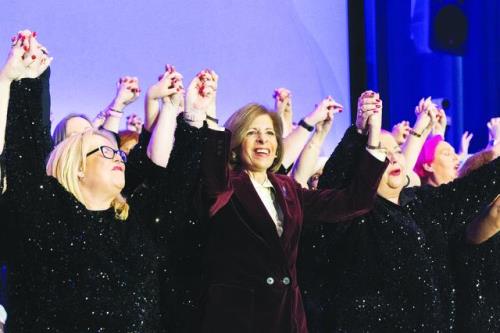
A few minutes later the stage was flooded with women dressed in black evening dresses. Women who either themselves or a member of their family has been diagnosed with cancer. These are women from the choir "Sea of change choir", who sang the song "Don't give up". As one of them mentioned, "we lost loved ones to cancer, even members of our choir. We continue to celebrate every small victory every day, but also those who succeeded".