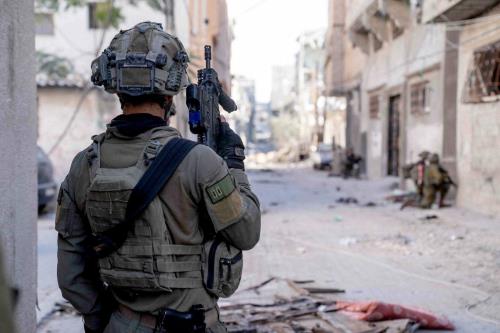
The center ravaged, hospitals under heavy fire, the population fleeing: Khan Younis remains today a theater of fierce fighting, against the backdrop of appeals from the United Nations to continue aid to civilians in the Gaza Strip and to save the service for Palestinian refugees.
Eyewitnesses reported that Khan Yunis was shelled for another night. The largest city in the southern Gaza Strip has become the epicenter of the war in recent weeks, with the Israeli army vowing to wipe out the militants of the Palestinian Islamist movement Hamas there.
Workers at the Amal ("Hope") hospital, one of the largest in the city, along with the Nasser Medical Center, spoke of battles at a short distance, shell fragments in his yard, lack of food…
"We left Nasser Hospital (…) under shelling and airstrikes. We don't know where to go, they didn't tell us where to go specifically. We are out in the cold, left to our own devices, without tents, without anything to survive," said a Palestinian who left the city to reach Rafah, further south.
An AFP journalist embedded with an Israeli army unit reported seeing the center of Han Younis flattened, buildings destroyed, while soldiers moved through mud and entered underground tunnels.
"Disastrous consequences"
In the besieged and battered enclave of Israel, where the humanitarian crisis is deepening, shelling has forced 1.7 million people out of a total population of 2.2 million to flee their homes, according to the UN.
More than half of the buildings in the Gaza Strip – 50 to 61% – have been damaged or completely destroyed, according to an analysis of satellite images by researchers at American universities, the findings of which were reported by the BBC on Tuesday.
Making matters even more ominous for the civilian population, the activities of the United Nations Relief and Works Agency for Palestine Refugees in the Near East (UNRWA) are now under serious threat after Israel alleged that 12 of its 30,000 workers took part in the attack of the 7th of October.
On that day, Hamas' military arm launched an unprecedented attack on southern sectors of Israeli territory, killing some 1,140 people, mostly civilians, according to an AFP tally based on official statements from the authorities.
About 250 other people were abducted and taken to the Gaza Strip. More than a hundred were released when a week-long truce was declared in late November. According to Israeli authorities, 132 still remain in the Palestinian enclave, but 28 are believed to be dead.
In retaliation for the Oct. 7 attack, Israel vowed to "wipe out" the Palestinian Islamist movement in power in the Gaza Strip since 2007, and its military operations have since killed at least 26,751 people, the vast majority of them women and children, according to with the Hamas Health Ministry.
Following the Israeli accusations against UNRWA workers, thirteen countries, including the US and EU member states, suspended its funding, demanding that the agency thoroughly investigate the alleged involvement of its members in the October 7 attacks.
"These decisions (…) will have devastating consequences for the population of Gaza. No other entity has the capacity to provide assistance of this scale" to the population that "urgently needs it", fourteen heads of UN agencies stressed.
No other organization can "replace or substitute for UNRWA's enormous capabilities, network, knowledge," insisted UN humanitarian coordinator for the Palestinian Territories Sigrinde Kaah after a closed-door Security Council meeting.
But for the Israeli government UNRWA is "fundamentally corroded" and allows Hamas to "use its infrastructure" to conduct military activities and "hide terrorists". This service, Israeli politicians constantly repeat, has no place in the "future" of the Gaza Strip.
A key ally of Israel – and the main funder of the agency -, the US considers that measures must be taken and "fundamental" changes must be implemented in UNRWA so that "things like this never happen again", although it recognizes that it carries out "critical" work .
Hamas in Egypt?
Alongside this belligerence, the US, Egypt and Qatar are continuing corridor negotiations to persuade Israel and Hamas to declare a new truce, following the one in late November that allowed the release of more than a hundred hostages in exchange the release of Palestinian prisoners.
Hamas leader Ismail Haniya confirmed yesterday that his movement had received a proposal for a new truce, the fruit of a meeting in Paris attended by CIA director William Burns and representatives of the governments of Qatar, Egypt and Israel.
"Hamas is examining the proposal" and preparing its response, he said, adding that officials of the Palestinian Islamist movement were invited to Egypt to "discuss the framework agreement" that emerged "at the Paris meeting" and "its implementation ».
Israeli Prime Minister Benjamin Netanyahu said yesterday, however, that Israel "will not withdraw the army from the Gaza Strip", nor is it going to accept the release of "thousands of terrorists" in exchange for the hostages.
An influential far-right minister, Itamar Ben Gvir, threatened on Tuesday to quit the government if Mr Netanyahu gives the green light to what he says is a "foolish" deal to free the 100 or so hostages still being held in the Strip. of Gaza.