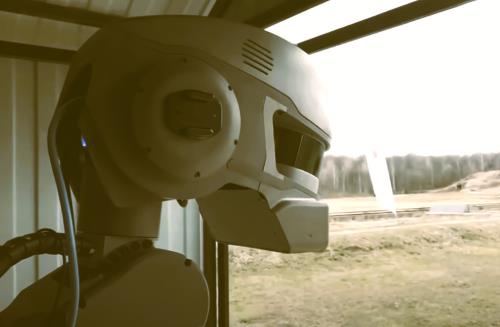
RAND believes that Moscow may see the robotization of the Armed Forces as a way to reduce its reliance on manpower
Both the Ukrainians and the Americans estimate that the Russian Army has lost almost 380,000 soldiers in Ukraine, while the wounded exceed 1.1 million.
While it's likely that these numbers are somewhat cooked up—that is, inflated—for American decision-makers, the losses they claim reinforce a trend that has already begun in the Russian Armed Forces: the replacement of soldiers by lethal and efficient robots.
In its research, the RAND think tank believes that in view of the unsatisfactory performance and low morale of Russian troops in Ukraine during the 2022 war, Moscow may see the robotization of the Armed Forces as a way to reduce its dependence from human resources.
As the report "Russia's Asymmetric Response to 21st Century Strategic Competition" states, the Russian military is seeking to replace unmanned capabilities for soldiers rather than augment them on the battlefield. It is noted that RAND is considered one of the most hardline in the US.
According to existing plans, by 2025, the share of robotic systems in the overall structure of weapons is supposed to reach about 30%.
Drones, robots and the algorithms that support them are supposed to be cheap force multipliers that will increase the effectiveness of military operations by avoiding heavy casualties and reliance on manpower.
The US report finds that despite official statements, Russians appear to be willing to accept a greater degree of machine autonomy and will likely approve fully autonomous systems if they become technologically feasible. However, Moscow may seek to regulate autonomous lethal weapons systems internationally to limit US use of force.
The Russians envision military drones and robots proliferating in the Armed Forces and taking on multiple combat, reconnaissance and support roles. Many of these tasks entail a much higher level of autonomy than is currently possible.
Relative to the US, Russia seems to be paying more attention to unmanned ground vehicles. Russian military scholars believe such vehicles could greatly reduce personnel losses in civil warfare.
According to existing plans, by 2025, the share of robotic systems in the overall structure of weapons is supposed to reach about 30%. Although US analysts believe that this is impossible in such a short period of time, this signals long-term goals.
Going forward, the key inputs of Russia's innovation system are human capital, financial resources and hardware, which will likely be negatively affected by the new wave of sanctions and export controls imposed on Russia in 2022. However, the Russian government has tools to offset some of the negative trends in selected sectors.
To be sure, the US report points out that Russia has a strong primary and secondary education system in science, technology, engineering and mathematics, and the 20-29 age group will grow in the next 15 years. The Russian government says the Americans are using a whip and a carrot to curb the brain drain. Furthermore, due to economic sanctions, the economic situation could potentially deteriorate to the point where migration becomes increasingly difficult.
The Russians will also use cyber and industrial espionage to gain access to essential software and hardware.
The Kremlin can withstand adverse conditions
Limited innovation networks and a weak institutional environment may likely constrain Russia's innovation system, but the Kremlin may seek science and technology partnerships with China.
International sanctions on Russia may make life difficult for planners of the future military, but the US report emphasizes that Russia has proven that it is possible to excel in some areas under adverse conditions. The pace and scope of robotization will likely fall short of the Kremlin's stated goals.
However, even if the Russians succeed in a limited way, RAND estimates that it will still have very serious consequences. If the Kremlin pushes for robotization and, as a result, Moscow believes that military operations become economically—and politically—cheaper, more efficient, and less dependent on the will of soldiers to fight, then the propensity to use military force could increase further.
Of course, the reasonable question someone would ask is whether the American Pentagon – which has carried out numerous invasions – has more innocent visions for its Army.
Source: in.gr