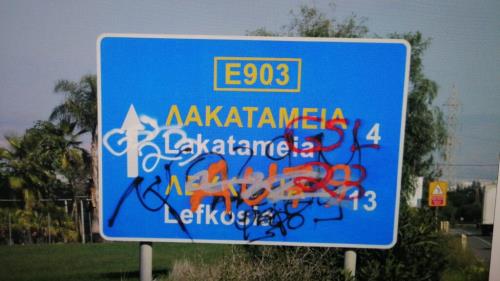
It is prohibited to write, engrave or design on a traffic signal, with pigments or in any other way, words, letters, figures, figures, numbers, pictures or slogans or to cause damage to a traffic signal or an information-direction sign
It is now a criminal offense to alter traffic signs in any way, with a law passed unanimously by the Plenary of the Parliament.
The relevant law proposal was submitted by DISY MP Nikos Georgiou. It amends the Road Safety Law to make it an offense to alter traffic signs in any way.
In particular, the law passed prohibits writing, engraving or designing on a traffic sign, with pigments or in any other way, words, letters, figures, shapes, numbers, images or slogans or causing damage to a traffic sign or on an informational-directional sign placed by the respective competent authority, as well as their movement, destruction, deformation or alteration.
In his statement to the Plenary, MP Nikos Georgiou referred to the frequent vandalism of traffic signals and information signs on the streets of Cyprus "by brainless people" and stated that the state should send a message of disapproval and deterrence and that these behaviors should attract legal consequences because they cause suffering, anxiety and insecurity and above all a risk to the public safety of citizens. He also said that many millions are being spent to restore these signs and that the issue is primarily an education issue.
Charalambos Theopeptou, MP of the Environmentalist Movement – Citizens' Cooperation, noted the importance of this specific law proposal, since, as he said, there is already a European regulation for automation in cars, which will in the future automatically recognize traffic signs for the speed limit. He added that for them to be able to read the labels should be correct and clean. He also said that various other automations are coming, so the standards should be followed very carefully.
The President of EDEK, Marinos Sizopoulos, said that the proposal is in the right direction, however, as he said, instead of repression, the conditions should have been created for prevention through education and the family. He added that by destroying the signs, messages are being sent to foreign visitors that Cyprus is a country without law, order and prevention. He noted that along with deterrent punishments for offenders and the message that the crackdown will be immediate and very serious, efforts should be made to cultivate a culture of correct behavior by everyone.
DIKO MP Christos Orfanidis said that he had also registered the matter for discussion at the Transport Committee. He noted that the risk of breaking the speed limit is one of the issues that arise through vandalism and another issue is the issue of orientation. At the same time, he said that the issue ridicules Cyprus in the eyes of foreign visitors.
At the same time he mentioned that the Department of Public Works has proceeded with offers to replace some signs with special digital printing signs from which any interferences can be easily removed. He asked everyone to make an effort to replace the signs everywhere.
DIKO MP Chrysanthos Savvidis noted that many signs are vandalized by minors and that there should be enlightenment of young people through school units, in order to solve the problem.
AKEL MP Valentinos Fakontis said that the control should be increased because the cost of replacing the signs is high and the taxpayer pays for it. He also said that more should be invested in prevention and a culture of respect for public property.
The deputy of DIKO Zacharias Koulias said that when you enter a country and see the road network, you understand the level of culture of the country and that this image with the signs creates a negative impression on visitors. At the same time, he said that many signs need to be replaced, since the colors have faded and are not readable. He also emphasized the need to prune trees and bushes on the road network so that they do not create problems.
The MP of DIPA – Cooperation Marinos Mousiouttas congratulated Mr. Georgiou for the law proposal as well as the competent departments that worked to bring this proposal to the Plenary in two sessions.