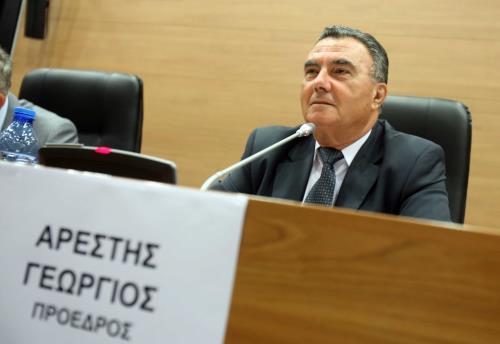
Giorgos Aresti speaks to the citizen for the first time at KYPE
The President of the body, Giorgos Aresti, who stated that he was satisfied with the work it produced, considers the reactions to the work of the Advisory Council regarding the appointments to the Semi-State Organizations to be unfair. In statements to KYPE he noted that it was the first time that the ordinary citizen had the opportunity to participate in the boards of such organizations without having to go through party procedures.
Giorgos Aresti declared that he was satisfied with the work done by the council, saying that they worked in harmony, consensually and produced a work "that is produced for the first time in Cyprus. In fact, within the narrow time limits set by the PtD". He noted that the council got to work in October and President Christodoulidis had requested that their recommendations be ready before Christmas.
He stated that the decisions of the Advisory Council were taken by consensus, unanimously in sessions that he always presided over. Mr. Aresti emphasized that they only relied on the expressions of interest sent to them and nothing else. They took into account, he said, the provisions of the general law 149 of 1988 which regulates the operation of all Semi-State Organizations, legal entities of public law and the relevant law that sets some special qualifications, criteria that a candidate must have for some Semi-States. He gave as an example that it is considered a special qualification for someone who would apply for the Board of Directors of THOK, to have something to do with the theater, the arts in general.
Asked if there was any interference with the members of the council, he replied: "No interference. How would we have (intervention), when 95% of our proposals were accepted by the Council of Ministers?"
He also stated that he was satisfied with the great acceptance by the Ministry of the recommendations of the Advisory Committee, noting that the Ministry justified as it should, based on the decision of the operation of the Advisory Committee, the 5% of the recommendations that it did not accept.
Asked to comment on the reactions that have been caused, Giorgos Aresti said that they are "very unfair. Because this Advisory Council worked diligently, under adverse conditions, we didn't even have a place to meet." They met, he said, either at the university where one of the members of the Advisory Board worked, or at a large company – an auditing firm, with which another member of the council worked. "We accomplished a remarkable task. I am sorry to say that the Advisory Council is being wronged by the attack it is being made."
The attack, he added, comes from two directions, one from those who were not selected, noting that they received a total of 1070 applications and to the Cabinet for the 11 Boards of Directors they proposed about 300 people. "Those who were not selected, it is normal to have a complaint. Not everyone could be selected, all 1070," he added.
The other category of reactions is from the parties, he said, which Mr. Aresti also finds normal, as he mentioned. "For the first time, the parties do not have the lion's share in the appointments of the Boards of the Parastatal Organizations. It is the first time that the ordinary citizen has the possibility to become a member of the Board of Directors of Hemikratikos, without having to go and beg and go through the party procedures. It is the first time this thing is done," he said.
In response to another question, he wondered why "the parties should be above the simple, anonymous citizen, who was given the opportunity to participate in these processes for the first time?". He respects the parties, he said, but their role is to determine policy and not to have a role in the final appointment of the state.
Mr. Aresti estimated that some executives or members of parties did not submit an application to the Referendum because they probably do not agree with the policy of President Christodoulides and did not want to serve and promote the goals of this government policy through the Semi-States. "How are the parties so sure that their executives applied and were not selected? We had no idea and the party or political position of each of the candidates was not our criterion. The form they filled out was neither red, nor blue, nor green, nor yellow. It was all the same."
Asked to comment on whether there are people who have a conflict of interest with the position they were appointed to, Mr. Aresti said they judged the candidates based on the information they had filled in the application. "We didn't have the opportunity and the way to do further research." They were concerned, he continued, about any personal interviews, but it was practically impossible with such a large number of applications. That's why in the form that an interested party filled out, he had 8 questions, he explained, to see some perceptions, personality and how he perceived the Organization he wanted to serve.
If in retrospect there is evidence on someone's CV that shows there is a conflict of interest – should an investigation be carried out and this is proven – there are corrective measures, he added. "The Council of Ministers can at any time ask someone to submit their resignation and appoint someone else. There are remedies. Why do some people tear their clothes? Why so much noise?'
TEPAK
For the Board of TEPAK, George Aresti said that the appointment of the members of the Board was not within the jurisdiction of the Advisory Council and to the question whether the PtD is entitled to terminate a member who has just been appointed, Mr. Aresti said that based on the general law 149, the President of the Republic and the Council of Ministers are entitled to request the resignation, but "I do not know the details of the matter". He noted that the Boards of TEPAK, the University of Cyprus, the Open University are not covered by legislation 149 of 1988.
English School
As proof that the wider society trusts the Advisory Board, Mr. Aresti mentioned that the parents' association of the English School requested from the PtD that the appointment of the members of the Board be made through the Advisory Board.
He noted that this was not within the remit of the Council in the first place, but it was the parents association that requested this procedure. "Let the message be received by those who knock on the Gnomodotiko and want to dismantle it. The good, correct role of the Advisory Council has been embedded in society," he said.
On the 26th of the month, he said, the applications for the Board of the English School expire and they will meet immediately after to choose the final list that they will send to the Minister of Education and she to the Council of Ministers.
Beyond that, he said, if the PtD has in mind to expand the powers of the Advisory Council, "I don't know. Maybe he does, but I don't know."