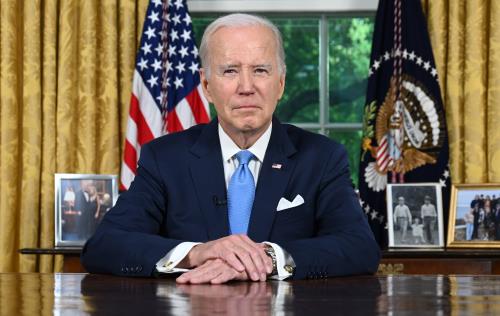
Biden "continues to believe" in a future Palestinian state
US President Joe Biden "continues to believe in the prospect and possibility" of a two-state solution in the Middle East, and in the establishment of a Palestinian state, but "recognizes that it will take a lot of work to get there," the spokesman for the National Council said today. White House Security John Kirby.
The US president discussed his position with Israeli Prime Minister Benjamin Netanyahu during a "30 to 40 minute" conversation the two leaders had today, the first since December 23, according to the spokesman.
Biden also welcomed Israel's decision to allow flour to be shipped to Gaza.
The United States continues to oppose a blanket ceasefire in Gaza, believing it will help Hamas militants.
"We support humanitarian pauses, as I said, to try to get the hostages out and more aid into the Gaza Strip, but we don't support a truce right now."
"I think it's important to remember that a ceasefire was put in place there on October 6."
At the same time, the White House expressed its "great concern" after the information from the occupied West Bank about the death of an American citizen.
A 17-year-old Palestinian, Tawfiq Azaq, a US passport holder according to his father, was killed by Israeli fire in Al-Mazra Al-Sharqiyya, east of Ramallah in the occupied West Bank, the Palestinian Wafa news agency and relatives of the youth said.
Regarding the Houthis, Kirby said the US "successfully conducted three defensive strikes" today against the rebels in Yemen. He stressed that the operations targeted missile launchers ready to strike in the Red Sea.
Houthi: We do not seek expansion of attacks in the Red Sea
Yemen's Houthis have said they have no plans to expand their attacks on ships in and around the Red Sea, beyond their stated goals of blockade Israel and retaliating against US and British airstrikes.
In an interview with Reuters, spokesman Mohammed Abdulsalam, who is also the lead Houthi negotiator in peace talks for the country's more than decade-long civil war, said the group had no plans to target its longtime enemies, Saudi Arabia. Arabia and the United Arab Emirates.
"We do not want the escalation to widen. That is not our request. We have imposed rules of engagement in which not a single drop of blood was shed and there were no major material losses," Abdulslam said. "It was pressure only on Israel, it wasn't pressure on any country in the world."
The Iran-allied Houthis, who control most of Yemen's populated areas, have attacked ships at the mouth of the Red Sea since October in what they say is a show of solidarity with the Palestinians by targeting ships bound for Israel.
"What the Yemeni people did in the beginning was to target Israeli ships heading to Israel without causing any human or even (any) significant material losses, just preventing the ships from passing as a natural right," Abdulsalam said.
"Now that America has stepped in and escalated the situation further, there is no doubt that Yemen will respond," he said.
The Houthi attacks have forced international shipping companies to reroute trade between Europe and Asia via the Cape of Good Hope, adding time and cost. The United States and Britain bombed Houthi targets last week in what they called an intervention to keep one of the busiest sea routes open.
"We don't want the conflict to expand in the region and we don't prefer that, and we are still working on de-escalation, but the decision is up to the Americans as long as they are still attacking," Abdulsalam said.
"Yemen is engaged in the response, and is interested in asserting or maintaining its position by preventing Israeli ships from heading to the occupied Palestinian territories."
The conflict in the Red Sea is one of those involving armed groups backed by Iran in the Middle East and has escalated since October, when Hamas militants attacked Israel, sparking an Israeli offensive that has since devastated the Gaza Strip.
Washington accuses Tehran — which leads an "Axis of Resistance" that includes Hamas, Lebanon's Hezbollah and groups in Syria — of trying to expand the conflict across the region.
Among other flashpoints, Hezbollah and Israel are exchanging fire on the border, while pro-Iranian paramilitaries have attacked bases where US troops are stationed in Iraq.
The Houthis, mountain fighters who seized Yemen's capital a decade ago, have maintained control through a years-long war against forces in the region, Saudi Arabia and the UAE, now in a sensitive phase of peace talks.
"We find no justification for taking any action against them, and we call on them to reject the militarization of the Red Sea or the presence of military forces in the region," Abdulsalam said of the Gulf Arab powers.
Abdulsalam said the Houthis have made their own decisions in the conflict and do not take orders from Tehran, although they maintain a close relationship.