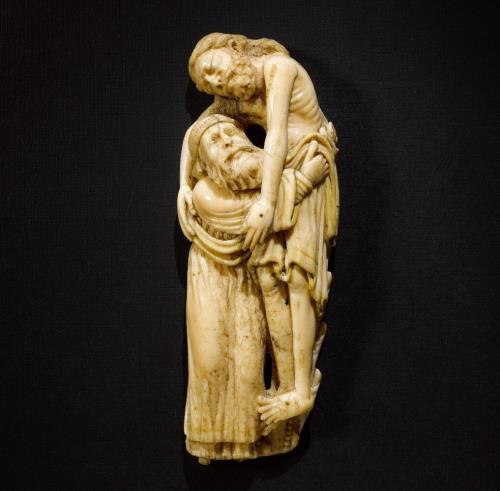
A few months ago the auction house Sotheby's quietly arranged the private sale of the sculpture to the Met, on the condition that it obtain an export license from the UK
New York's Met and London's Victoria and Albert Museum (V&A) have expressed their keen desire to acquire a 12th-century sculpture entitled 'Deposition from the Cross'. A few months ago the auction house Sotheby's quietly arranged the private sale of the sculpture to the Met for just over £2 million, on the condition that the work obtain permission to be exported from the UK.
However, UK Arts and Heritage Secretary Stephen Parkinson has now suspended the export licence, which offers the V&A a chance to match the price. According to the government's art export review committee, the sculpture represents "one of the most important cultural objects" whose export from the country has come under discussion in the last 5 years. It should be noted that these laudatory formulations are something extremely unusual for the people of this committee.
The question is whether the V&A will be able to raise the funds needed to prevent this important sculpture from going abroad. The 'Deposition' dates from around 1190-1200 and was probably made in York. 18 cm high, it was originally part of an impressive set of the Passion or Death of Christ while the surviving part depicts Joseph of Arimathea gently lowering the body of the dead Christ from the Cross.
Tim Pestell, member of the export review committee and archaeologist at Norwich Castle Museum, describes it as "a truly remarkable object, both for its early dating and for its exquisitely skilful carved woodwork", and Sandy Heslop, expert in medieval art at the University of East Anglia, claims it is "the first indication of tenderness in a work of art".
The "Decapitation" is closely related to another fragment, probably from the same set of Passions, depicting Judas at the Last Supper. This smaller piece was first recorded in 1769 in Wakefield, Yorkshire, and was donated to the V&A in 1949. It is likely that the 'Deposition' along with Judas formed part of an impressive ecclesiastical icon. So far no other fragments of the set have been identified, however, the rarity of the sculpture also has to do with the material of its creation, which is believed to be walrus tusk bone.
The Deposition (c. 1190-1200) was originally part of a much larger set of Passion paintings. Photo:: © UK Department for Culture, Media and Sport
The "Removal" was made from an unusually large piece of walrus tusk. The trade in seahorse ivory and tusks has been significantly restricted in the UK from 2022. But even so and despite any restrictions, these do not appear to involve ancient objects of high artistic, cultural or historical significance.
Little is known about the origins of "Unfixation". We know that it was acquired by their marriage in 1933 to John and Gertrude Hunt, collectors and dealers of antiques based in London. However, the fact that Gertrude Hunt was born in Germany raises the question of whether the work has origins in the Nazi period. Of course, as the sculpture was probably made in York in the 12th century, it is just as likely that it has always remained in the UK. Its illegal purchase has never been reported.
In 1982 Gertrude Hunt offered it on long-term loan to the V&A, where it remained until the end of 2022. In recent years it has been exhibited in the museum's medieval rooms, along with the Judas fragment. The V&A, or any other potential UK buyer, now has until February 2 this year to meet the Met's £2 million price tag. This deadline could be extended by four months if there is a serious effort to raise the funds.
Paul Williamson, the former V&A curator who originally secured the Deposition's loan to the museum in 1982, describes it as an astonishingly rare piece and "the most important English Romanesque sculpture remaining in private hands". He adds: "If you hold it in your hands it will reveal to you the most wonderfully heartbreaking character."
A V&A spokesman was unable to comment on whether the museum would eventually seek to acquire it, but stressed that the object had been on loan to the museum for 40 years, adding: "We recognize the unique historical and artistic significance of this rare piece." The Met's press office declined to comment.
With data from ArtNewspaper