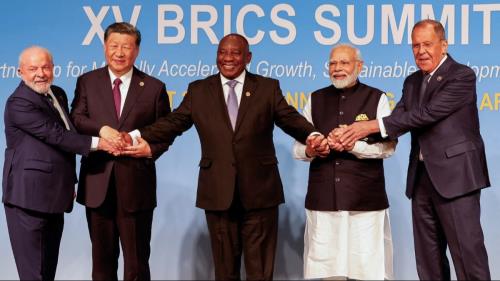
The BRICS group doubles its members and multiplies trade between them
New conditions in the world economy and changes, to an extent that cannot yet be estimated, are created by the enlargement of the group of states comprising Brazil, Russia, India, China and South Africa that will now be recognized as BRICS+ as it has been decided that new accessions will not change the name of the bloc, created from the initial letters of the core states.
Although the differences, as well as the priorities, of the five original countries are large in several areas, such as the economy and foreign policy, this does not negate the value of closer cooperation among the countries of the "Global South", as they quite often define themselves.
These are also large countries, not only in terms of population but also economically, and the addition of two large economies, such as those of Saudi Arabia and the United Arab Emirates, with a key role in oil production, further enhances the economic power of the group.
The founding of BRICS in 2006 was a pledge by the four – initially – states (South Africa joined in 2010) to promote "the reform of international financial systems to reflect changes in the global economy".
They also argued, according to a joint statement, "that there is a great need for a stable, predictable and more diversified monetary system".
The integration of the new states
Since the beginning of the year, Saudi Arabia, the UAE, Egypt, Iran and Ethiopia have joined the organization, doubling the number of members and increasing the financial weight of BRICS+ even more.
The countries belonging to the group represent just under half of the world's population (45%) with about 3.5 billion people and almost 1/3 of the world's GDP as they collect 28 trillion. dollars.
Also, the BRICS+ have a leading position in production as well as in global oil reserves: Almost 1/2 of the "black gold" reserves.
Only three of the new BRICS+ states, Saudi Arabia, Iran and the United Arab Emirates, hold almost half of the world's oil reserves (47.4% of OPEC).
The financial footprint of the organization is already large, but even greater are the possibilities provided, through partnerships, to the member states.
China, the largest economy in the bloc and second largest in the world after the United States, is a country with huge energy needs and the inclusion of Saudi Arabia and the United Arab Emirates will likely provide opportunities as well as an additional sense of "security" to the supplying Beijing with oil.
The developments that followed the Russian invasion of Ukraine, with Russia turning to China for energy resources, are indicative of the changes taking place.
De-dollarization
The development of a common currency is one of the topics discussed at the meetings of the leaders and one of the issues of considerable interest as the creation of an alternative currency to the dollar would significantly change the landscape of global monetary transactions.
Already, and much more steadily, the use of local currencies in transactions between the states of the BRICS+ group is progressing, which may not have the scope and weight of a common currency, but it is an important change and for some a first step towards de-dollarization of transactions supported by Russia.
In this context, it has been discussed to create a system like the one that exists in the IMF with special drawing rights, an accounting asset with which the members of the Fund "participated".
The creation of the BRICS bank (New Development Bank, NDB) is an attempt to diversify and "liberate" itself from institutions such as the World Bank and the International Monetary Fund, but also to access funds for countries that would not be able to do so and in fact with their own national currencies.
As NDB president and former Brazilian president Dilman Rousseff recently said, “We estimate that we will lend between 8 and 10 billion dollars a year. Our goal is for around 30% of what we lend to be in local currency."
Russia in charge
The inclusion of the five new states in the BRICS bloc coincides with Russia taking over the presidency of the political organization for 2024. And Vladimir Putin's statement that the main goal is to strengthen the role of BRICS+ in the international economic system is obviously not without significance. but also transactions in national currencies.
Additions are not automatic in these associations of states, but they cannot be underestimated, or even more so, ignored. The upgrading of the economic reach of BRICS+ is easy to see, but equally important is the geopolitical value acquired by the "Global South" alliance.
For the wary and skeptical, it is enough to recall the agreement (and the restoration of diplomatic relations, which had been broken for years) between Shiite Iran and Sunni Saudi Arabia, brokered by China, just a few months ago, which caused a sensation.
Source: ot.gr